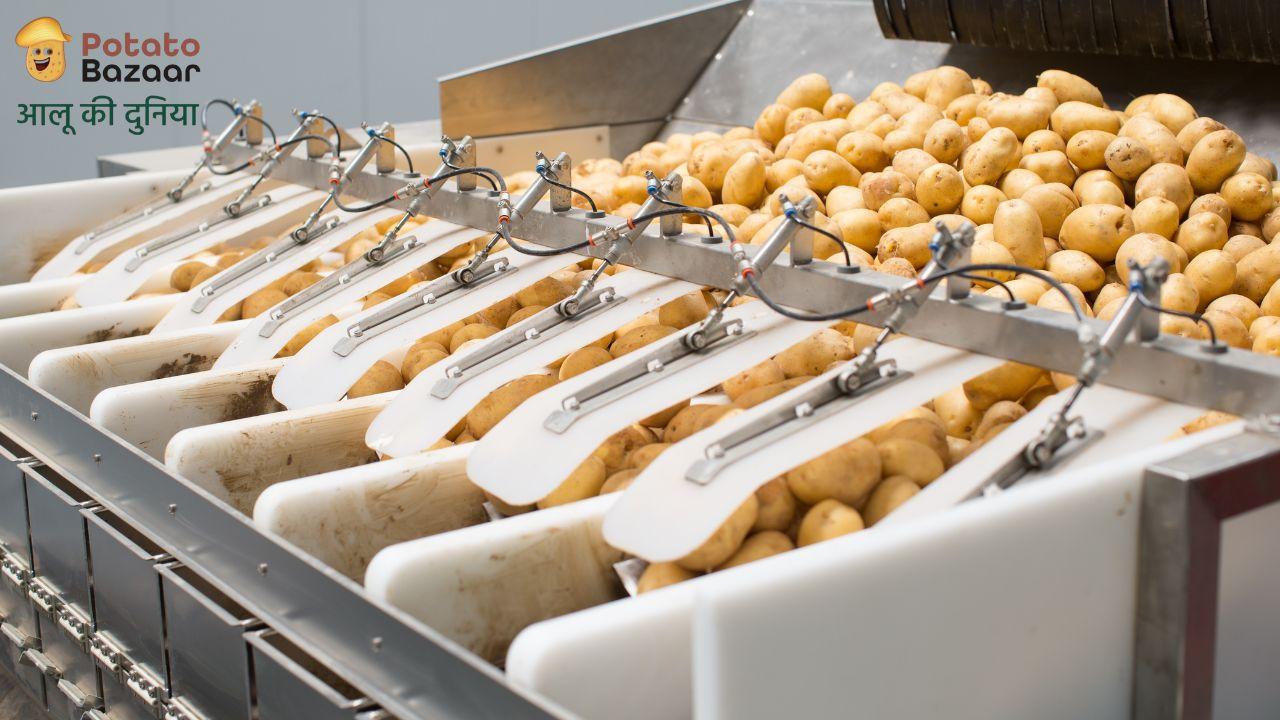
A processor hunting for a grading line. A machinery maker with no way to reach buyers three states over. A cold-storage operator sourcing a replacement compressor. A packaging manufacturer whose export certification is invisible to the exporters who need it. The potato industry runs on far more than potatoes — and finding the machinery, packaging, transport, storage and services it depends on is still a matter of who you already know.
Potato as a commodity is what the industry writes about, tracks, and prices. But almost no business in the value chain runs on potatoes alone. A cold-storage operator needs compressors, insulation and racking. A chips or fries plant needs a grading line, a peeler, a fryer, and food-safety-grade packaging. A trader needs a transporter with genuine cold-chain capability. A farmer aggregator entering contract farming needs a coordinator who can place volume reliably. An exporter needs a testing lab and a packaging vendor who understands the destination market's requirements.
These allied products and services are not a footnote to the potato business — they are what makes it operable. And they are exactly where discovery breaks down: no one writes about the machinery vendor, the packaging supplier, or the contract-farming coordinator, and no infrastructure exists to help either side find the other.
For a buyer of allied products or services, the search usually starts from a position of near-total blindness.
A regional chips processor commissioning a new plant needs a grading-and-sorting line. Suitable vendors operate across at least three states, but the processor's shortlist runs to the two companies it met at a trade show two years ago — not because they're necessarily the best fit, but because they're the only two it knows exist.
A cold-storage operator sourcing an insulation retrofit or a replacement compressor has no potato-industry-specific equipment directory to search, so it spends weeks calling contacts and comparing quotes gathered on inconsistent terms.
An exporter shipping to Bangladesh needs food-grade packaging meeting that market's phytosanitary spec. Four or five suppliers likely qualify, but there's no single view to compare them on certification, capacity and lead time — each conversation starts from zero.
A farmer FPO with aggregated volume wants to place it through a contract-farming coordinator rather than the open mandi. Coordinators exist, in belts like Punjab and Haryana, but the FPO has no way to find one outside its members' existing networks.
In each case, the buyer isn't short of options. It's short of a way to see the options that already exist.
The same gap runs the other way. A machinery maker in Ludhiana has just built a new sorting line for grading larger volumes at higher throughput. Its natural buyers are cold-storage operators and processors in clusters like Agra, Nashik and Bengaluru — three separate markets it has no efficient way to reach at once, so it relies on regional agents and repeat trade-show visits to cover ground that should be searchable in minutes.
A packaging manufacturer holds certifications specifically suited to potato exports — food-safety and cold-chain-compliant packaging built for the category. When a would-be buyer searches for a supplier with exactly that certification, the manufacturer has no discoverable presence to be found through; its qualification exists on paper, not in any searchable listing.
A regional transporter operates reefer trucks on established potato routes, with capacity that would suit traders or exporters it has never worked with. That capacity is visible only to shippers already in its network — everyone else has no way to know the trucks exist.
A contract-farming coordinator operating across Punjab and Haryana wants to reach FPOs and aggregators considering contract arrangements. Without a listing anywhere a farmer group would think to search, the coordinator's reach stops at whichever aggregators it has already worked with.
Every one of these sellers has a real, sellable offering. What they are missing is not demand — it's a place where that demand can find them.
A general B2B marketplace lists potato-relevant vendors alongside everything else on the platform — industrial machinery, packaging and logistics for every sector at once. A potato-industry buyer wades through results with no sector-specific structure, and a seller's listing competes for attention against unrelated categories. A general search engine is no better: it returns web pages, not comparable listings, with no way to filter by capacity, region or certification.
What neither can do is constrain supply to potato-relevant vendors and structure it the way the industry actually thinks — by category (machinery, packaging, transport, storage, services), by region, by the specifications that matter in this sector specifically. That constraint is not a limitation; it is the entire value of industry-specific infrastructure. A marketplace built for the potato industry's allied products and services is a different kind of tool, not a smaller version of a general one.
A working allied-products marketplace organises listings the way the industry actually operates — machinery, packaging, transport, storage and services as distinct categories, each searchable by region and specification. Profiles are verified, so a first-time buyer has reason to trust an unfamiliar vendor. Enquiries are structured, so comparing four or five suppliers on the same criteria is realistic rather than a series of unconnected phone calls. And sellers keep their listings current, so the marketplace stays a place buyers return to, rather than a directory that quietly goes stale.
Done well, both sides get something durable: buyers find qualified allied vendors in a fraction of the time cold outreach takes, and sellers get discovered by buyers who were already looking for exactly what they sell. That is the difference between a marketplace and a listing — one is infrastructure the ecosystem can rely on, the other is a page nobody maintains.
Potato Bazaar's Marketplace lets machinery makers, packaging suppliers, transporters, cold-storage operators, contract-farming coordinators, and other allied service providers list their offerings — and lets buyers across the potato ecosystem discover, compare, and connect with them through structured digital workflows.
It covers everything a potato business needs that isn't potatoes themselves: processing and grading machinery, packaging (crates, sacks, cold-chain packaging), refrigerated transport and logistics, cold-storage facility rental, contract-farming coordination, seed and input supply, agri-consulting and inspection services, testing labs, and technology or insurance/credit services built for the sector. The common thread is that all of it is currently discovered through personal networks rather than any structured, searchable listing.
A general B2B marketplace lists potato-relevant vendors alongside every other sector on the platform, so a buyer has to wade through unrelated results with no sector-specific structure, and a seller's listing competes for attention against categories that have nothing to do with potatoes. A general search engine returns web pages, not comparable listings, with no way to filter by capacity, region, or certification. A potato-industry-specific marketplace constrains supply to relevant vendors and structures listings the way the sector actually thinks.
Sellers — machinery makers, packaging manufacturers, transporters, cold-storage operators, contract-farming coordinators and other service providers — create a profile describing their category, region, capacity and certifications, which is then verified before it goes live. A verified profile gives a first-time buyer a reason to trust a vendor it has never worked with, which is the main barrier that keeps sellers invisible to buyers outside their existing network today.
The same criteria across every vendor in the comparison: capacity or output specification, region and delivery lead time, relevant certifications (food-safety, cold-chain, phytosanitary, as applicable), and whether the vendor has a verified track record on the category being sourced. The value of a structured marketplace is that these criteria are captured consistently for every listing, so a buyer can compare four or five suppliers on the same basis instead of reconstructing that comparison from separate, unstructured conversations.
A directory is a static list — useful for a first lookup, but it doesn't structure listings by category and specification, verify who is on it, or support a comparison across multiple vendors at once. A marketplace does all three: category-based listings searchable by region and spec, verified profiles, and structured enquiry flows that let a buyer raise a request and compare responses from several sellers side by side. That structure is what keeps a marketplace live and useful rather than a page that quietly goes stale.
Get the latest market intelligence, price trends, and industry news delivered to your feed.
Where the industry reads it first
Growers, traders, processors and cold-store operators, in one place. Prices, policy and the stories behind them — forwarded, not algorithm-ranked.
Potato Prices
Today's mandi rates
Variety Guide
Compare all 64 varieties
Export Guide
Step-by-step process

Out of every 100 potatoes India grows, about 70 are eaten fresh as a vegetable, about 10 are processed into chips, fries, flakes and other products, 7–8 are kept as seed and about 1 is exported; about 5 are lost on the farm and 1 more in the market. Processing has grown from under 1% of the crop in the late 1990s to about 10%: 6.0 million tonnes in 2023, double 2014. Frozen fries exports reached 2,77,109 tonnes in 2025-26. Why only one potato in ten is processed, where processors buy, and what it means.

UP potato averaged ₹860 a quintal by August, against ₹1,088 last year. A bigger crop, cold stores 85% full, slow release and costlier transport to other states explain the fall.

India grows three times as many potatoes as the US, but a US hectare gives twice the harvest. Five American habits that could help Indian farmers grow more, lose less and sell better.
♥ Reader support
Indian Potato covers nothing but potatoes: prices, seed, storage, processing and export, free to read. If our work helps you, support the initiative. Every contribution goes into more reporting from the field.
Why we ask →UPI · cards · net banking · secured by Razorpay