Industry Spotlight · Specification
“A Grade” Means Four Different Things. Which One Is Your Buyer Using?
Grading shorthand travels badly. The same two words mean something different to a processor, a wholesaler, a retail buyer and a quick-commerce platform — and the gap is discovered on arrival.
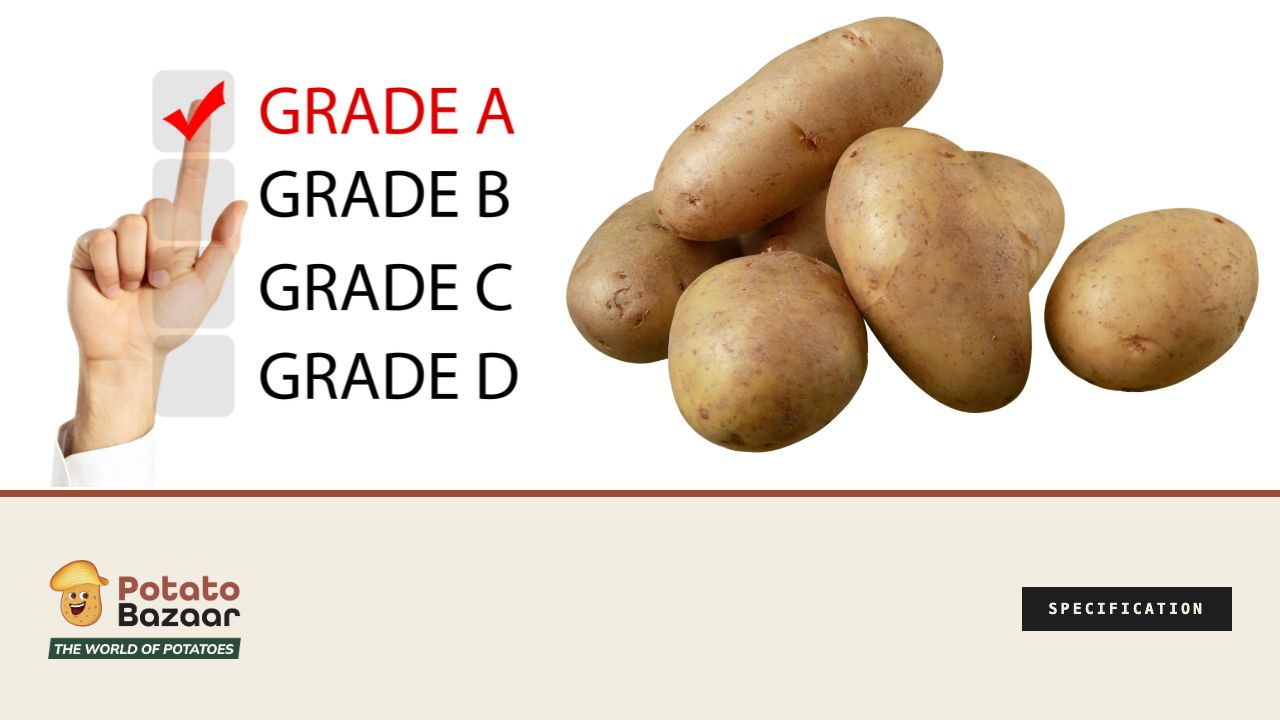
“A grade” is the most efficient phrase in the potato trade and the most expensive. It is efficient because everyone uses it and nobody has to explain it. It is expensive because what it refers to shifts depending on who is saying it, and the shift is invisible until a consignment arrives and the receiving end disagrees with the dispatching end about what was sold. If you are choosing a machine to grade to a written specification, see our guide to potato grading and sorting machines.
There is no single recognised standard behind the phrase as it is used in day-to-day trade. What exists instead is a set of local conventions, each internally consistent and mutually incompatible. A trader in one belt and a processor in another can use the identical words in good faith and mean materially different consignments.
The fix is not a better label. It is describing the thing itself.
Four buyers, four working definitions
The processor
Cares most about what happens inside the potato. Dry matter, sugar content, internal defects, and a size band suited to the line. A tuber that looks unremarkable can be exactly right; a handsome one can be rejected on internal grounds that are invisible at the gate.
The wholesale trader
Cares about what moves and what keeps. Size consistency, absence of visible damage, and condition good enough to survive onward handling. The working definition is practical rather than technical: will this sell on without complaint.
The retail or modern-trade buyer
Cares about appearance and uniformity, because the consumer is choosing by eye. Skin finish, colour consistency, freedom from greening and blemish, and a tight size band. Internal quality matters, but visible quality is what gets the load accepted.
The quick-commerce buyer
Cares about appearance and about shelf life under fast handling. Sprouting tendency, condition on arrival and packing suitability weigh heavily, because the consignment moves through more hands and more quickly than in traditional retail.
Descriptors that travel between all four
| Descriptor | Why it survives translation | How to state it |
|---|---|---|
| Variety | Unambiguous and verifiable | Name it explicitly |
| Size band | Measurable by both parties | State the range, not a letter |
| Skin and appearance | Observable at both ends | Describe finish and colour |
| Visible defects | Countable rather than judged | State what is acceptable and at what proportion |
| Sprouting | Objective at the time of inspection | State condition at dispatch |
| Damage and greening | Observable and disputable only in degree | State tolerance explicitly |
These descriptors are proposed as practical trading language, not as a recognised grading standard. Where a formal standard applies to a particular transaction, that standard governs.
Nobody has ever argued about a size range stated in millimetres. The arguments are always about letters. The machines that produce those size bands are catalogued on the grading and sizing systems page.
Writing a specification both sides can check
Replace the letter with the attributes. Variety, size range, skin condition, defect tolerance. Four lines that take a minute to write and remove the entire category of dispute.
State tolerances, not ideals. Every consignment contains some proportion of material outside the target. Saying what proportion is acceptable is more useful than describing perfection neither party expects.
Agree how it will be checked. A specification nobody can verify at the destination is a wish. Say how a sample will be drawn and what it will be measured against.
Send a photograph. Not a substitute for a written specification, but it settles more disagreements than any paragraph, and it costs nothing.
Most of this is discipline rather than technology, but the point where it usually fails is the listing — the moment a consignment is described to someone who cannot see it. A listing that carries variety, size band and condition is checkable at the far end; one that says “A grade” is not. That is the practical contribution a marketplace such as Potato Bazaar makes to this problem: structured description in place of shorthand, so both parties are looking at the same consignment before it moves. Assessing whether the goods match remains between buyer and seller.
Connect Directly
Describe what you are selling precisely
List with variety, size and condition stated, so buyers know what they are agreeing to.
The short version
The phrase is shorthand for four different things and it does not travel. State variety, size range, skin condition and defect tolerance instead. It takes a minute at dispatch and removes the most common reason consignments are argued over on arrival.
Is there an official definition of A grade potatoes in India?
Not one that governs everyday trade. The phrase is a local convention rather than a recognised standard, and different buyer types apply it to materially different specifications. Where a formal standard does apply to a particular transaction or export, that standard governs and should be named explicitly.
Why do processors and retailers disagree about grade?
Because they are assessing different things. A processor is concerned with internal characteristics — dry matter, sugars, internal defects — while a retail buyer is concerned with appearance and uniformity, since the consumer chooses by eye. The same consignment can satisfy one and fail the other.
What should a potato specification contain?
Variety, size range stated as a measurement rather than a letter, skin and appearance condition, acceptable proportion of visible defects, and sprouting condition at dispatch. Adding how the consignment will be checked on arrival prevents most remaining disagreements.
Why is stating tolerances better than describing quality?
Because every consignment contains some proportion of material outside the target, and both parties know it. Stating what proportion is acceptable gives a checkable threshold, whereas describing an ideal creates an expectation that no real consignment meets.
Does a photograph help?
Considerably, though not as a replacement for a written specification. A photograph settles disagreements about appearance quickly and costs nothing to send. The written specification remains necessary for anything that cannot be seen, such as size distribution or variety.
Editorial disclosure: This is an Industry Spotlight published in partnership with Potato Bazaar (S.K. Agri Exports Private Limited). The editorial framing, research and references are the responsibility of the IndianPotato.com editorial team. The descriptors proposed here are practical trading language, not a recognised grading standard, and no universal definition of any grade letter is asserted. Where a formal standard applies to a transaction, that standard governs. Potato Bazaar does not grade, inspect or certify consignments.


