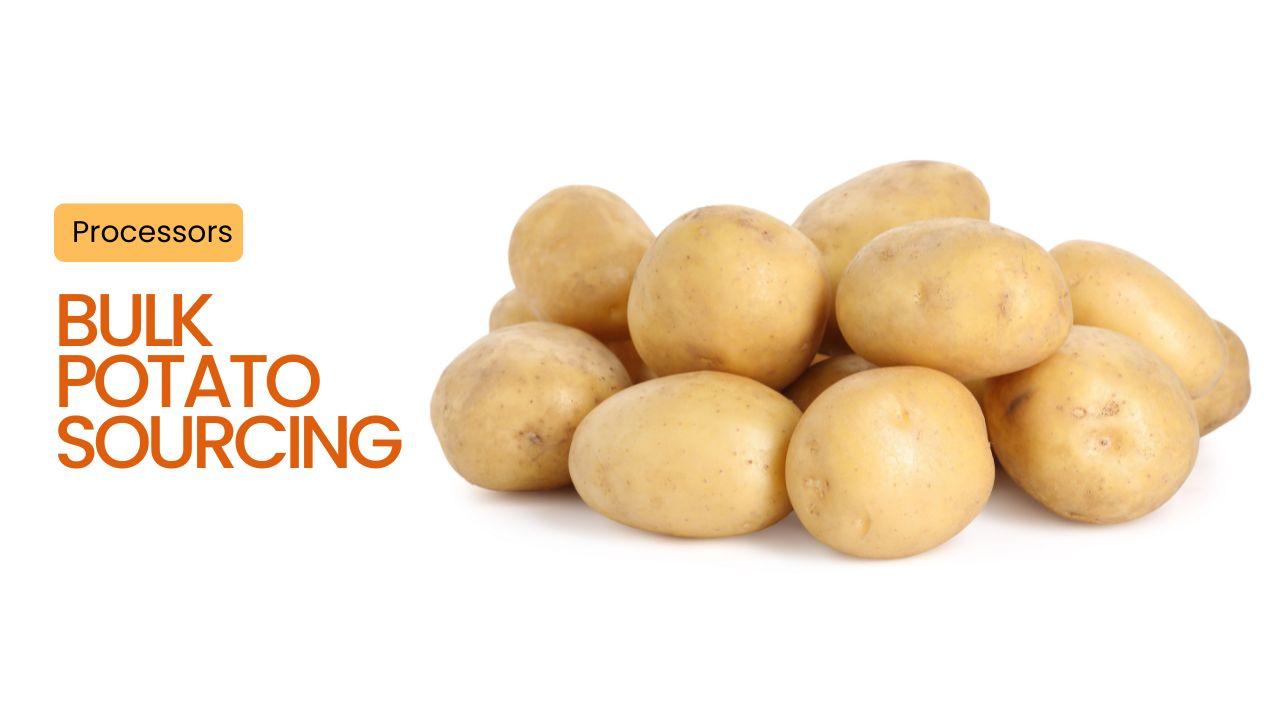
Inconsistent supply, quality–quantity mismatches, and fragmented sourcing networks cost Indian potato processors crores every season. Here’s how digital RFQ-based bulk procurement is fixing it.
Bulk potato sourcing for Indian processors looks straightforward on paper. India produced 58.57 million tonnes of potatoes in 2024-25 — the official Final Estimate released by the Department of Agriculture & Farmers Welfare (PIB, 17 March 2026) — making India the world’s second-largest producer after China. Yet ask any procurement head at a chips, frozen-fries, flakes, or starch plant — from Gujarat to Uttar Pradesh to West Bengal — and the story is uniform: sourcing the right tonnage of the right grade at the right price, week after week, is the single hardest operational problem in the business.
India’s potato processing industry faces three structural challenges in bulk procurement: inconsistent supply, quality–quantity mismatch, and sourcing inefficiency. This piece looks at the buyer side — how processors source raw material, why traditional procurement leaks value at multiple stages, and how digital RFQ workflows are emerging as a structural fix. Earlier in our editorial series we examined digital platforms in potato trading and crop diagnostic and advisory apps for farmers.
The headline 58.57 MT number hides three uncomfortable facts. First, only an estimated 7–8% of Indian potato production is processed industrially (chips, fries, flakes, starch, dehydrated combined), against 60–70% in countries like the Netherlands and the United States. Second, the geographic concentration is brutal: approximately 77% of total production sits in just four states — Uttar Pradesh (~30%), West Bengal (~22%), Bihar (~17%) and Gujarat (~8%) — and a single rabi season produces most of the year’s tonnage. Third, the share of that tonnage meeting processing-grade specification (dry-matter, sugar, tuber size, defect-free) is a small fraction of what crosses the mandi.
For a mid-sized Indian chip plant running a 3-tonne-per-hour line — the typical scale for an established regional or second-tier branded processor — that means sourcing roughly 48 tonnes of conforming raw potato every working day, around 280 days a year. The procurement team needs a continuous pipeline of bulk potato suppliers India-wide who can deliver to spec, on time, at landed cost that keeps margins intact. The supplier base that can do that is small, fragmented, and not searchable through any single channel — until recently. (PepsiCo-Lay’s flagship Indian sites and Balaji Wafers run multi-line facilities at 5–7 TPH per line; mid-tier brands typically run 2–4 TPH per line.)
Bulk sourcing in this context means buying potatoes in lot sizes of one full truckload (8–16 tonnes for a typical Tata 1109 or 14-wheeler) or larger — for processing, repacking, export, or institutional resale. The buyer is rarely a household; it is a plant, a packer, or an aggregator with downstream commitments that punish delay.
The single most reported pain point in Indian processor procurement is inconsistent supply. The causes are structural:
The combined effect is that the procurement head wakes up not knowing whether tomorrow’s 50-tonne requirement will be met by preferred suppliers in Agra, spot lots in Banaskantha, or a scramble for stored tonnage at a 10–12% premium. Daily mandi prices swing sharply within a single week during phase transitions. Without visibility into who has what, where, at what grade and price, procurement is permanently reactive.
The second structural problem is the gap between the volume offered and the volume that actually clears specification. A single processing-grade lot is screened on at least six parameters:
| Parameter | Typical Spec — Chip-Grade | Typical Spec — Fry-Grade | Why It Matters |
|---|---|---|---|
| Dry-matter content | 20–24% | 20–22% | Drives finished-product yield and oil pickup |
| Reducing sugars | < 100 mg/100 g | < 150 mg/100 g | Above-spec sugar causes dark fry colour (Maillard browning) |
| Tuber size | 45–80 mm | 50–90 mm | Slicer/strip-cutter compatibility, finished-piece yield |
| Specific gravity | > 1.080 | > 1.075 | Texture, crispness, oil absorption profile |
| Defects (bruise, scab, greening) | < 5% | < 5% | Direct yield loss at peeling and inspection |
| Variety | Kufri Chipsona 1/3/4, Lady Rosetta, Atlantic | Kufri FryoM, Santana, Innovator | Locked into the product’s sensory and frying profile |
A lot that fails on any one parameter is visually indistinguishable from a passing lot at the mandi. The processor learns the truth only at the plant gate when QC pulls samples — by which point the truck has moved, freight is sunk, and rejection means distress resale or a return-at-seller-expense dispute. First-pass reject rates on processing-grade bulk lots typically run 5–12% in normal conditions, climbing to 15–20% in stress windows (peak summer, post-festival, post-wet-spell storage rot). Most of that loss is preventable with better pre-purchase visibility.
The variety question is the deepest part of the iceberg. Out of India’s 64 released potato varieties (ICAR-CPRI plus private developers), only a handful — Kufri Chipsona 1, 3, 4 and Kufri FryoM from ICAR-CPRI, plus contract-grown Lady Rosetta, Atlantic, Santana, and Innovator — meet sustained processing-grade specifications. A grower selling “potato” does not always know which variety is in his store; a verified supplier on a structured platform does.
Behind both the supply and quality problems sits a third, deeper one: sourcing inefficiency. The traditional buyer’s playbook — maintain a Rolodex of 30–80 traders, walk the mandis daily during peak season, rotate phone calls for verbal quotes, negotiate each lot, arrange transport, accept or reject at gate — is how Indian potato has been bought for decades. It works, but it scales badly. Doubling capacity doubles procurement headcount; adding fry-plus-flake-plus-starch grades triples spec-sheet overhead. Information stays trapped in WhatsApp groups and phone books — not searchable, comparable, or auditable.
The cost shows up in three places: time-to-procure (a missed lot today is a production hole tomorrow), price discovery (without simultaneous quotes, the buyer cannot tell whether a quote is fair until after the fact), and supplier development (a team running 30 phone calls a day cannot also qualify new bulk potato suppliers India-wide).
Quantify the inefficiency and the business case becomes self-evident. Take an indicative mid-sized Indian chip plant — 3 TPH capacity, 16-hour shifts, 280 working days/year, around 13,500 tonnes of annual processing-grade off-take. At a landed cost in the typical processing-grade range of ₹1,200/quintal (Agmarknet processing-grade typically clears ₹1,100–1,400/qtl outside extreme seasons), that is an annual raw spend of roughly ₹16 crore. The recoverable losses on that base look like this:
Combined, the four levers run to roughly ₹1.1–1.3 crore of annual recovery on a ₹16 crore raw spend — about 6–8% in the upside case, with typical realised gains landing closer to 2–4%. These are not theoretical figures: they are the operating gap between procurement running on phones and Excel versus structured digital tooling. Scale up by an order of magnitude for a multi-plant chain sourcing 1.5–2 lakh tonnes annually.
An RFQ — Request for Quotation, also called a Bulk Enquiry — is a standard B2B procurement instrument: a buyer posts a structured requirement (volume, grade, location, delivery window, payment terms) and multiple qualified suppliers respond simultaneously with quotes the buyer compares side-by-side. RFQ workflows are old news in metals, packaging, chemicals, and machinery. In Indian agricultural commodities they have, until recently, been almost non-existent.
The structural unlock for potato is that the supplier base is finally discoverable. Rural India accounted for 488 million of the 886 million Indian internet users in 2024 (IAMAI–Kantar, Internet in India 2024), and platforms like Potato Bazaar are aggregating verified farmers, cold-storage operators, and traders into one directory. A processor can now post a single RFQ — “75 tonnes Kufri Chipsona 3, 50–80 mm, dry matter ≥21%, delivery Gujarat plant gate, payment 14 days” — and have qualified responses within hours.
A well-designed bulk-enquiry feature changes procurement economics in five ways:
The same flow works for sellers: a verified farmer-producer or aggregator with 200 tonnes of stored chip-grade lists inventory and receives structured processor enquiries — which is what makes Potato Bazaar useful on the sell side too. For deeper context, see our analysis of digital platforms in Indian potato trading.
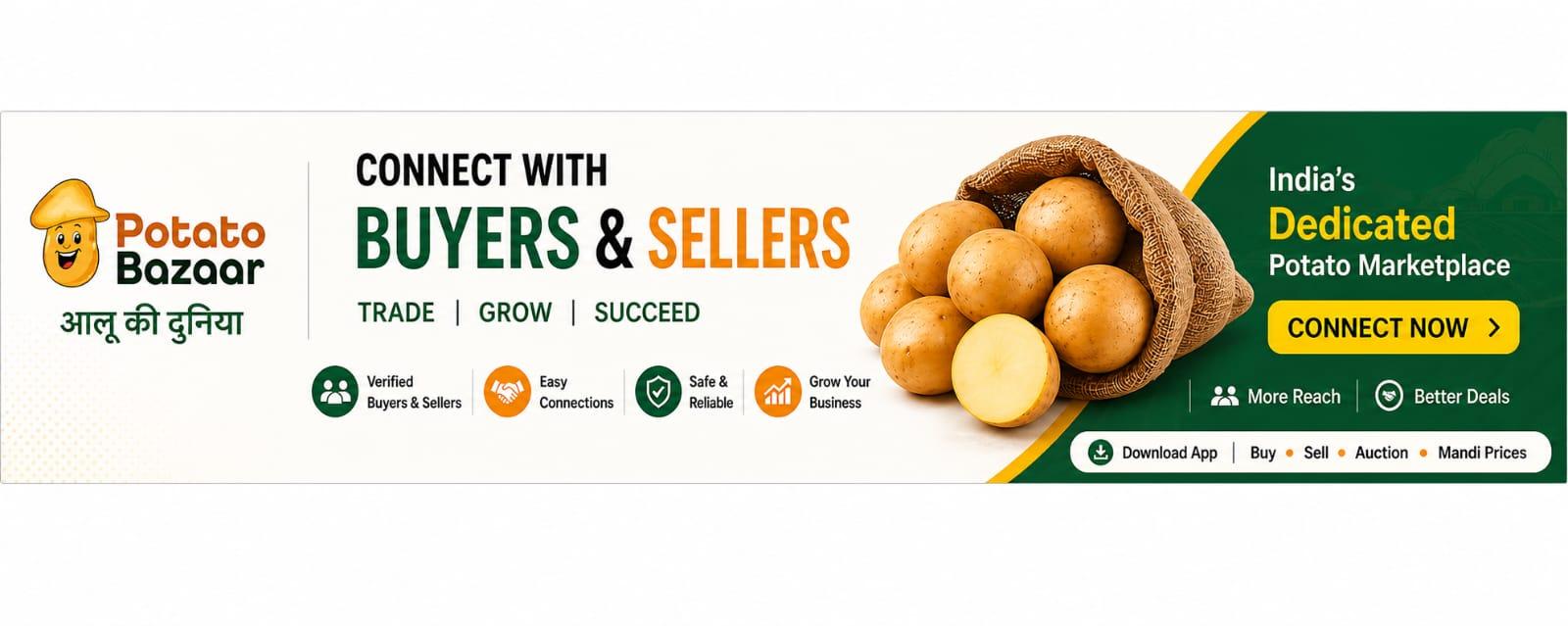
Potato Bazaar’s Bulk Enquiry (RFQ) feature is built around exactly this workflow, tuned to Indian potato realities. A processor opens the Android app, taps Bulk Enquiry, fills the structured spec — tonnage, variety, grade, size band, dry-matter limits, delivery point, payment terms — and submits. The enquiry is routed to verified suppliers with matching profiles (variety stock, geography, capacity, track-record rating). Suppliers respond in-app with quoted price, available tonnage, and earliest dispatch date. The buyer reviews quotes side-by-side and proceeds to confirmation.
What distinguishes this from a generic marketplace is the verification layer: suppliers are screened for variety claims, storage infrastructure, prior transaction history, and KYC. For a processor, a fake quote that wastes a procurement cycle is more expensive than an honest no. The platform folds in live mandi-price benchmarks so the buyer can sanity-check quotes in real time — and because the same platform serves the sell side, established suppliers already know the spec discipline the platform enforces.
The cumulative effect: bulk potato sourcing moves from phone-and-Rolodex craft to structured, auditable, scalable operating discipline. None of this replaces the senior buyer’s judgment — it gives that judgment a much larger and more reliable information base.
RFQ workflow is a tool, not a strategy. The strategic shift it enables is the move from opportunistic spot buying to a multi-tier sourcing portfolio that mixes spot, repeat, and contract relationships across seasons. The processors who execute this well share four habits:
None of these habits require digital tools to exist; they become operationally feasible at scale when supplier-discovery and RFQ layers are digital. A team with a phone book runs two of the four for one plant; the same team with structured RFQ tooling runs all four across multiple plants. For the equipment side of the same improvement programme see our potato flakes processing-line manufacturers hub, and our ICAR-CPRI overview covers the variety-research pipeline feeding processing-grade supply.
Indian potato processing capacity is expanding. The MOFPI Pradhan Mantri Kisan Sampada Yojana and PLI schemes for processed foods have brought significant new capacity into chips, frozen fries, flakes, and starch — and the announced pipeline through 2028 is substantial. Demand for processing-grade tonnage will grow faster than total production. Procurement is the bottleneck that decides who captures that demand and at what margin.
Three trends will define the next five years. First, digital RFQ workflows will move from optional to standard, the way GST e-invoicing moved from optional to mandatory in B2B billing. Second, traceability will become a competitive asset — export markets, QSR chains, and institutional buyers increasingly require lot-level traceability from field to plant. Third, contract farming for processing varieties will deepen, with grower-to-processor matching happening through digital marketplaces.
The processor who can buy bulk potatoes through a single structured channel, against a written spec, from verified counterparties across producing belts, with simultaneous price discovery and an audit trail — is the processor best positioned for the next decade. The farmer-aggregator who can sell potatoes to processors directly, with quality verified at source and payment certain, captures more of the value chain than ever. Both sides converge on the same answer: digital, RFQ-based, verified, transparent. It is no longer a pilot.
Potato Bazaar’s Bulk Enquiry feature lets processors post a structured RFQ — grade, variety, tonnage, delivery point — and receive verified quotes from suppliers across India in hours, not days. Free to download on Android.
 Download Now
Potato Bazaar App
Download Now
Potato Bazaar App
Get the latest market intelligence, price trends, and industry news delivered to your feed.
Where the industry reads it first
Growers, traders, processors and cold-store operators, in one place. Prices, policy and the stories behind them — forwarded, not algorithm-ranked.
Processing Companies
Top manufacturers
Cold Storage Guide
Subsidy, loans & setup
Company Directory
Find processors & suppliers

A chips packet is a metallised multi-layer laminate filled with nitrogen. What each layer does, why nitrogen replaces air, how long chips stay crisp in different films, India's pack sizes, the bags used for raw potatoes, and FSSAI rules.

Sugar inside a potato decides whether chips and fries come out golden or brown. ICAR-CPRI's faster glucose and sucrose test needs only 10 g of chopped potato extracted in 80% isopropyl alcohol; the extract keeps more than three days and matches the juice method. What a chipping potato must pass, the steps, chemical maturity at 75, 90 and 110 days, and who should use it.

Cold-stored or partly damaged potatoes can still become potato flour, sooji, daliya, gluten-free cookies, lactose-free burfi, gulab jamun, jalebi, halwa premix and a petha-style preserve. ICAR-CPRI's nine methods take any variety and any dry matter. What each product is, how long it keeps, which suit a vrat, and how to license them.
♥ Reader support
Indian Potato covers nothing but potatoes: prices, seed, storage, processing and export, free to read. If our work helps you, support the initiative. Every contribution goes into more reporting from the field.
Why we ask →UPI · cards · net banking · secured by Razorpay