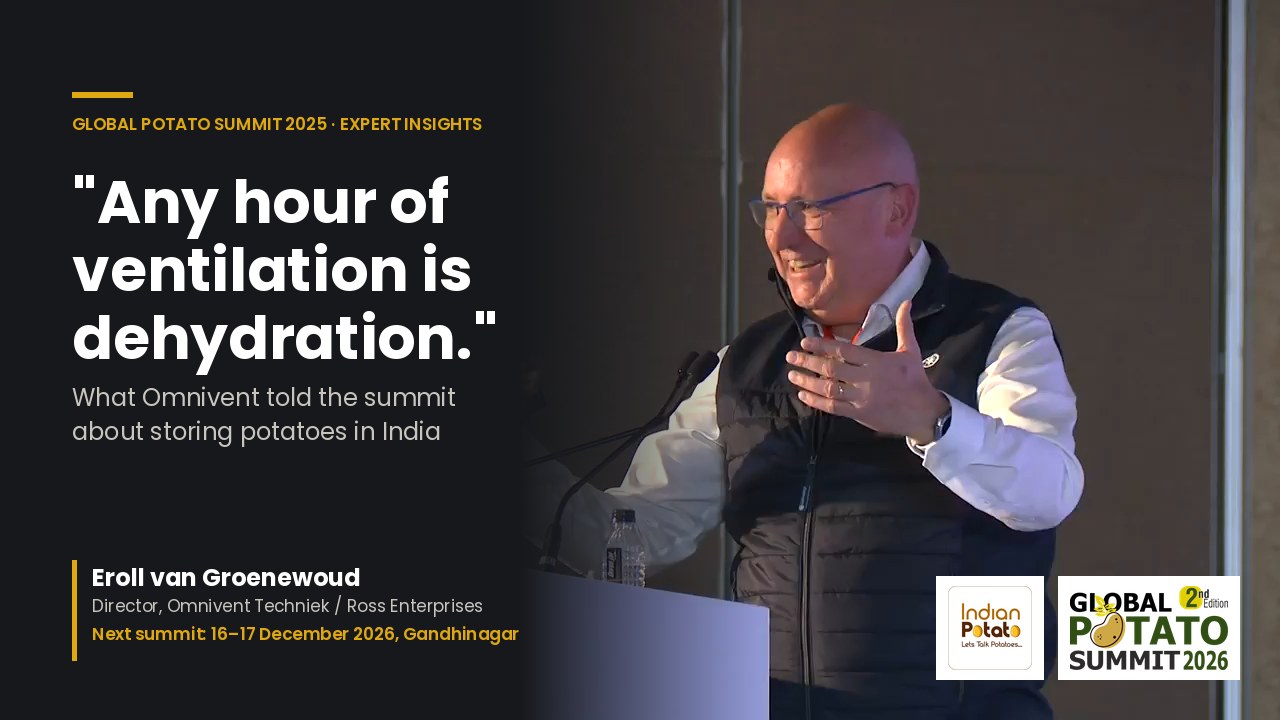
A Dutch storage engineer whose company runs about 400,000 tonnes of potato storage in India stood on the Global Potato Summit stage and reduced the whole subject to one sentence: every hour a store's fans run, the crop loses water. Design for the fewest hours and you keep the weight, the quality and the December price. This is the talk, the figures he gave, the slides he showed, and what an Indian cold-store owner should take from it.
Speaking at Global Potato Summit 2025, Eroll van Groenewoud of Omnivent Techniek and its Indian partner Ross Enterprises argued that potato storage is won or lost at the design stage. His rule is that any hour of ventilation dehydrates the crop, so a store should be sized from a heat-load calculation built on the region's own climate data, run four to five hours a day, and hold potatoes to the end of December. He said storage cannot cure a bad crop, only stop it getting worse; that renovating an existing building is often the better investment; that box stores and fast intake lines are coming to India; and that Indian buyers decide four to five months before commissioning, which is too late for equipment that ships from Europe. The figures are his, from the stage.
Omnivent is a Dutch maker of storage ventilation and climate systems. Van Groenewoud said the company began surveying Indian storage in 2008, concluded its systems had to be adapted to local conditions before they could work here, and now has about 400,000 tonnes of storage capacity in the country, storing to the end of December.
Ross Enterprises is the Indian half. The slide behind him gave the outline: established in 2015, corporate office in Gurugram, working in cold chain. Its solutions list runs from Omnivent agri cold stores and palletised frozen stores to wooden boxes, intake lines from the Dutch handling maker Bijlsma Hercules, grain silos and warehousing. Van Groenewoud said Ross was the first to hold a contract with PepsiCo that covered designing, building and operating a store as well as supplying the processing chain, which is what made it the partner Omnivent wanted.
The reason for a partner was put plainly. He travels 70 to 80 countries and cannot be in India ten times a year; the client speaks Hindi, Gujarati or Punjabi and he speaks Dutch; and, in his words, "you decide very late," which makes getting equipment here on time the hard part. More on that below.
The talk was short and quotable. These are his lines, taken from the recording, and what each means for a cold-store owner in Agra, Deesa or Hooghly.
Any hour of ventilation is dehydration. Anything you do inside the store is dehydrating your crop.
Weight loss in store is not bad luck. It is running hours. A store that has to run its fans all day to hold temperature is losing saleable kilos every day it does.
Why do we store until the end of December? Because the systems only run for four or five hours per day.
Long storage is a design outcome, not a setting. If the store was sized to cope rather than to rest, December is out of reach whatever the thermostat says.
Storage is not a hospital. We cannot cure what is bad. We can only prevent it from getting worse.
Bruised, immature or field-heated potatoes go in bad and come out worse. The store's job starts at intake, and the quality ceiling is set before the door closes.
We have only 2 percent losses. If we don't use the potato for processing, we use it for the cows.
His account of a minister's answer. Feeding rejects to cattle is not a loss of zero; the potato was not grown for the cow. Count losses at the price the crop was meant to fetch.
Renovations could be interesting, because eventually you have already the building.
The thousands of existing stores in Uttar Pradesh, Gujarat and Bengal are not stranded. Putting a modern ventilation system into a sound building can beat a greenfield build on cost.
Don't build big if you don't have the financials. Start small, earn the money, and then improve and increase.
A first cell that pays for itself is worth more than a large store financed on hope. The system is meant to be added to.
By the time we have to take the decision, it is four or five months in front of commissioning. That's way too short.
Equipment is made to order and shipped. Decide in the spring for a store that must be cold by the March harvest, not in the autumn.
The method he described starts outside the building. Omnivent collects climate data for the region where a store will stand, looks at the supply chain around it, and looks at the building itself, new or existing. Solar radiation on the walls at 35 to 40 degrees matters because it adds to the heat the system must remove, and removing heat means running hours. From that comes a heat-load calculation that fixes the cooling power needed to keep the fans to a few hours a day.
Every white block is an hour the crop rests and holds its water. A store built to a heat-load calculation buys those white blocks up front; a store that runs all day pays for them in lost weight, every day, for eight months.
He took the obvious objection head on. Designing for minimum running hours "maybe increases your investment." His answer was the horizon: a system bought for 25 to 30 years, so the extra capital, spread across three decades of stored crops, "is maybe not that big." The three goals he named for every design were storage losses, product quality and energy efficiency, and he added that if a system would not serve those, "it could be that we will not sell it to you."
New store, renovation, box or bulk, intake line, or a second opinion on a quote you already have. Tell us the tonnage, the place and the season, and we put you in front of the right people, including the people in this talk.
The sharpest passage was about how losses are counted. Over breakfast some years ago, he said, an Indian minister told him the sector's storage losses were only 2 percent, because whatever is not fit for processing goes to the cattle. His reply: "You don't grow the potato for the cow. It's grass, not a potato." The point was not the minister but the mindset. A reject fed to livestock is booked as zero loss when it is a loss of the whole processing price.
From there to the line he repeated: storage is not a hospital. It cannot restore what came in damaged, so the challenge he set the room was to improve quality before the store, and then to hold it. The pay-off he offered was seasonal: a store that carries the crop past the monsoon and the market's troughs to the end of the year.
On what to build, he was unfussy. Three kinds of system, he said, are already installed in India for the processing sector, and some of the parts can be made locally:
And renovation of an existing building, with a new system inside it, "could be more financially interesting than building a new store."
The Netherlands is small enough, he joked, to cross by fighter jet in a minute and ten seconds; India is a country where Nashik to West Bengal is four days by road. The supply chain is the challenge, and the store's front door is where it lands. With Bijlsma Hercules, Ross has built an intake that unloads several tractors at once, empties 50 kg bags to bulk at about 20 tonnes an hour, grades, and fills a cell in three to five days. The target, "as a starting point," is ten to eleven months of storage.
Boxes were the growth line. Ross will build about 40,000 wooden storage boxes this year, he said, with the aim of 70,000 to 80,000 next year, alongside assembling Bijlsma intake lines in India. For a processor that is the box-versus-bulk decision arriving with local supply behind it, which is the question the NAPSO storage webinar takes up this week.
His warning on timing applied, he stressed, to India "definitely" but to other regions too. A store is designed, then discussed, and by the time the order is placed it is four or five months before commissioning. Production time plus shipping from Europe, for parts not yet made here, does not fit in that window. The advice to the sector was one line: start planning early, so the equipment is in for this season "and not in two years."
Indian buyers, he said, start this clock four to five months before the store must be cold. Two of the four steps alone can use that up.
Ross describes its own method as a four-P approach, and the slide behind him listed it as four pillars:
The last part of the talk was a film for OmniCuro, the control system that began, he said, as "a kind of simple computer" 25 to 30 years ago. His view of where storage goes next is that a store should tell its owner how it is performing rather than hand over data to analyse: "only providing you the necessary information that you need as a store owner or store manager." Simplicity by intuition, in his phrase, so the manager can concentrate on the job outside.
"Wind, rain, sun: the elements which make us humble. Outside, the elements of nature are in control. Inside, our storage system is in control."
From the OmniCuro film shown during the sessionEditorial note. This piece reports Eroll van Groenewoud's talk as he gave it. Every figure, from the 400,000 tonnes to the 80,000 boxes, is the speaker's own, said from the stage. Quotes are taken from the organiser's recording and checked against the slides shown. IndianPotato.com handles enquiries for Global Potato Summit 2026.
He is Director of Omnivent Techniek, a Dutch maker of potato storage ventilation and climate systems, and of Ross Enterprises, its Indian partner based in Gurugram. He gave the Expert Insights session on modern technology in potato handling and storage at Global Potato Summit 2025.
Every hour a store's fans run, air moves over the potatoes and takes water from them, which is lost weight. Omnivent designs stores from a heat-load calculation based on the site's climate so that the system needs to run only four to five hours a day, which is what allows storage to the end of December with less weight loss.
According to the speaker, renovation is often the better investment because the building already exists and the modern ventilation or cooling system can be installed inside it. He also advised owners without the finance for a large store to start small, earn from the first cell, and expand.
Further ahead than four to five months. Van Groenewoud said Indian buyers typically decide four to five months before commissioning, which is too short once production time and shipping from Europe are counted, since not all parts are made in India yet. He advised planning early so equipment arrives for the coming season rather than two years later.
An Indian cold-chain company established in 2015 with its corporate office in Gurugram. Its slide at the summit listed agri cold stores with Omnivent systems, palletised frozen stores, wooden storage boxes, intake lines with Bijlsma Hercules, grain silos and warehousing. The speaker said it will build about 40,000 boxes this year and aims for 70,000 to 80,000 next year.
Global Potato Summit 2026, the second edition, runs on 16 and 17 December 2026 at the Mahatma Mandir Convention and Exhibition Centre in Gandhinagar, Gujarat. IndianPotato.com handles enquiries about attending and exhibiting.
Building new, renovating an old store, choosing between box and bulk, or fitting an intake line: send us the tonnage, the place and when you need it cold. We connect you with the right suppliers, including the people in this talk, arrange meetings at Global Potato Summit 2026 in December, and say plainly when something will not pay.

Indian Potato Team
Editorial Desk · IndianPotato.com
We cover the potato as an industry — varieties, agronomy, storage, processing and trade — for the growers, cold store operators and processors who work in it. Where a figure is a company's own claim, it is reported as theirs.
Get the latest market intelligence, price trends, and industry news delivered to your feed.
Delegate passes, exhibition stalls, sponsorship or travel for 16–17 December 2026 at Gandhinagar. Tell us what you need and we will come back with current rates.
Where the industry reads it first
Growers, traders, processors and cold-store operators, in one place. Prices, policy and the stories behind them — forwarded, not algorithm-ranked.
Potato Prices
Today's mandi rates
Variety Guide
Compare all 64 varieties
Company Directory
Find processors & suppliers

Royal HZPC Group’s Herman Verveld at Global Potato Summit 2025: three global trends, two models, a call to open seed exports, and why new varieties need new growing recipes.

Same region, same cold store, same temperature and humidity — and one lot comes out fine while the other does not. Sovindra Chaudhary of Agristo Masa on where potato quality is actually decided: maturity, curing, bruising, field heat, handling and transport, long before the chamber door.

Diesel, waiting hours, empty kilometres and rejected loads never appear on a transporter's invoice. After six years moving potatoes from farm gate to factory gate, Sovindra Chaudhary opens the ledger he actually works from.