Can India Export Seed Potatoes? HZPC Says It’s “Almost Impossible” Today
Three global trends, two models and one warning about growing new varieties the old way. What Royal HZPC Group’s commercial chief told the Global Potato Summit, and what it asks of India’s potato trade.
Indian Potato Team · Editorial Desk · 27 September 2026
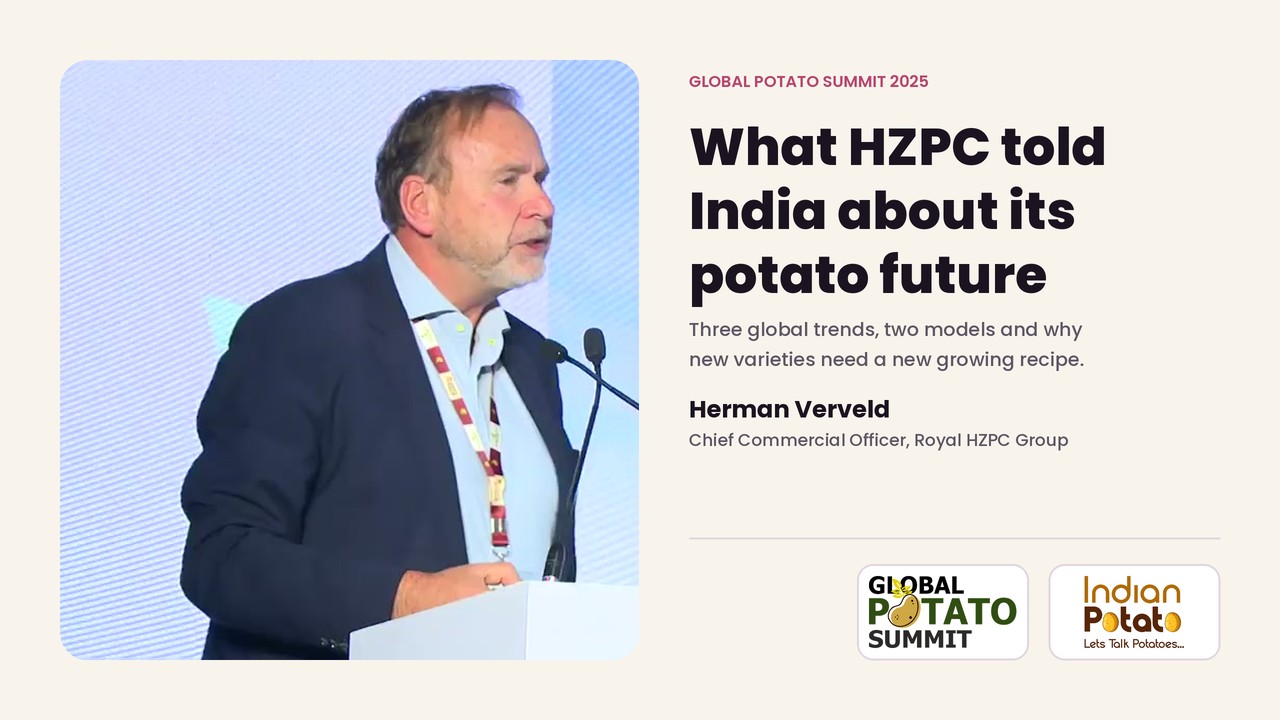
Herman Verveld, Chief Commercial Officer, Royal HZPC Group, at the Global Potato Summit 2025 Expert Insights session in the National Capital Region.
The short answer
Speaking at Global Potato Summit 2025 in the National Capital Region, Herman Verveld of Royal HZPC Group said India, “number two in potato”, sits at the centre of the world’s population growth and could export far more, including seed, if borders open through bilateral agreements. He argued India’s table market will move from traditional to differentiated potatoes, driven by home delivery and younger consumers, and warned that newer varieties only pay if they are grown differently from the old ones.
SessionGlobal Trends in Potato Demand, Production and Processing and India’s Future Role
SpeakerHerman Verveld, Chief Commercial Officer, Royal HZPC Group
WhereGlobal Potato Summit 2025, National Capital Region · Expert Insights
01 · Three trends
Trade politics, climate and people: the three forces he picked
Verveld opened by narrowing a long list of global trends to three, and asked of each one what it means for India’s role in potatoes. Because India is a global player, he said, it has to deal with global issues, and they are happening today.
World & trade politics
Monetary pressures, government protection and sanctions shape who can sell where. India has to understand that playing field and take a position in it.
Climate change
It keeps moving. He noted this year’s potato season in India already differed from last year’s.
Demographic shifts
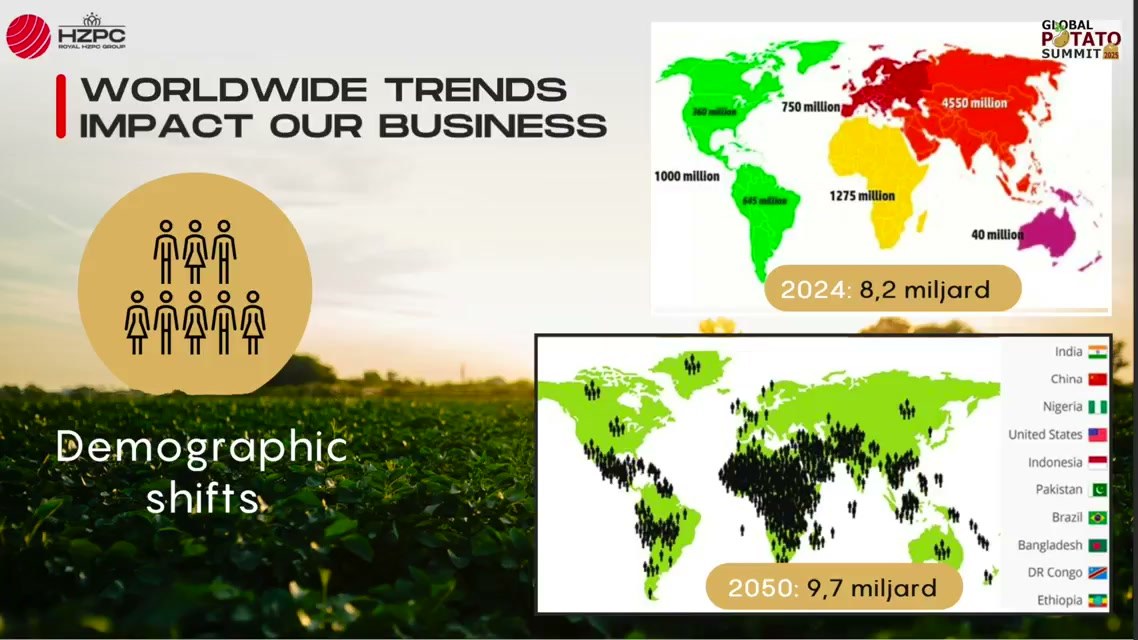
Where the world’s people are added decides where potato demand grows fastest. On his map, that is India, its neighbours and Africa.
His slide on demographic shifts. The population figures are his slide’s.
2024
8.2 billion
2050
9.7 billion
India
China
Nigeria
United States
Indonesia
Pakistan
Brazil
Bangladesh
DR Congo
Ethiopia
In his words, that is “a unique opportunity for India because it has a big home market which keeps on growing”, with more opportunity in the markets around it. In the mature markets, he said, potato is flat or declining and the business consolidates; where population grows, the market grows faster.
02 · Seed exports
The door he wants opened: Indian seed potatoes abroad
India already consumes, processes and exports some potatoes. Speaking as a potato seed breeder, Verveld said he also sees room for India to export seed, and that it is shut today.
“If I’m looking from a potato seed breeder, I also do see nice opportunities for India doing seed exports. Today it’s almost impossible to do that.”
Herman Verveld, Royal HZPC Group
His ask was of government: open borders and sign bilateral agreements with other countries, so that India’s seed can reach the growing markets on his map.
03 · Room to grow
How much more can potato grow? “We still can gain a lot”
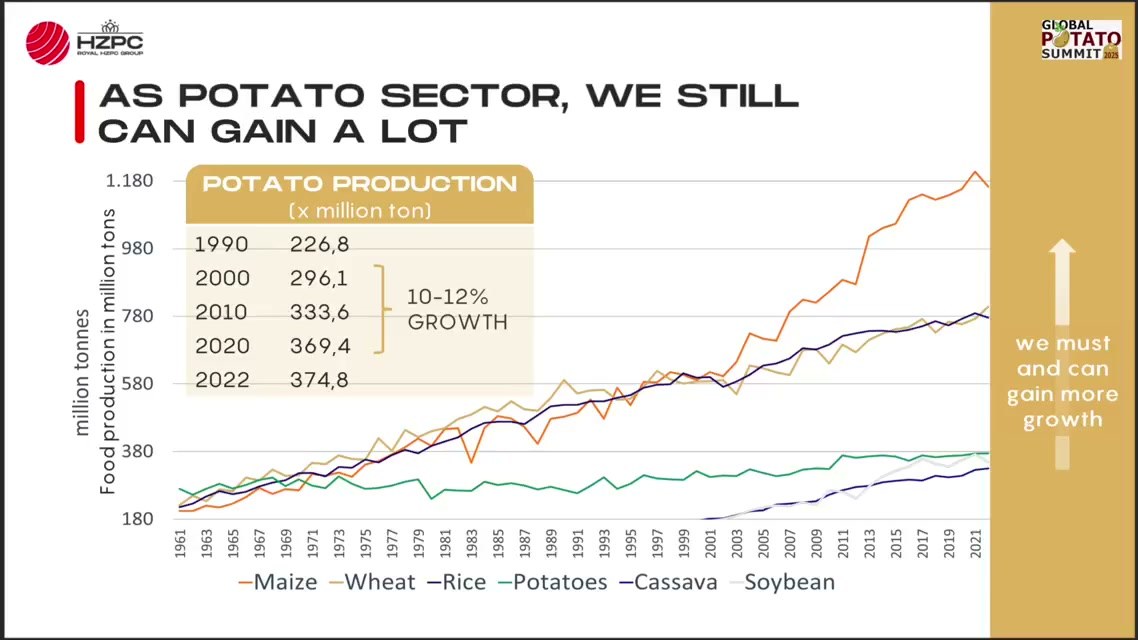
Set beside maize, wheat and rice, he said, potato sits in a different position: nutritious, sustainable and possible to grow in many circumstances, yet still far from its potential. His slide gave world potato production by decade.
1990226.8
2000296.1
2010333.6
2020369.4
2022374.8
World potato production, million tonnes, as shown on his slide, which labels the rise “10–12% growth” a decade. The figures are his.
“As potato sector, we still can gain a lot”: potato against the other staples, 1961–2022.04 · Model 1
Where does India sit on the food-development curve?
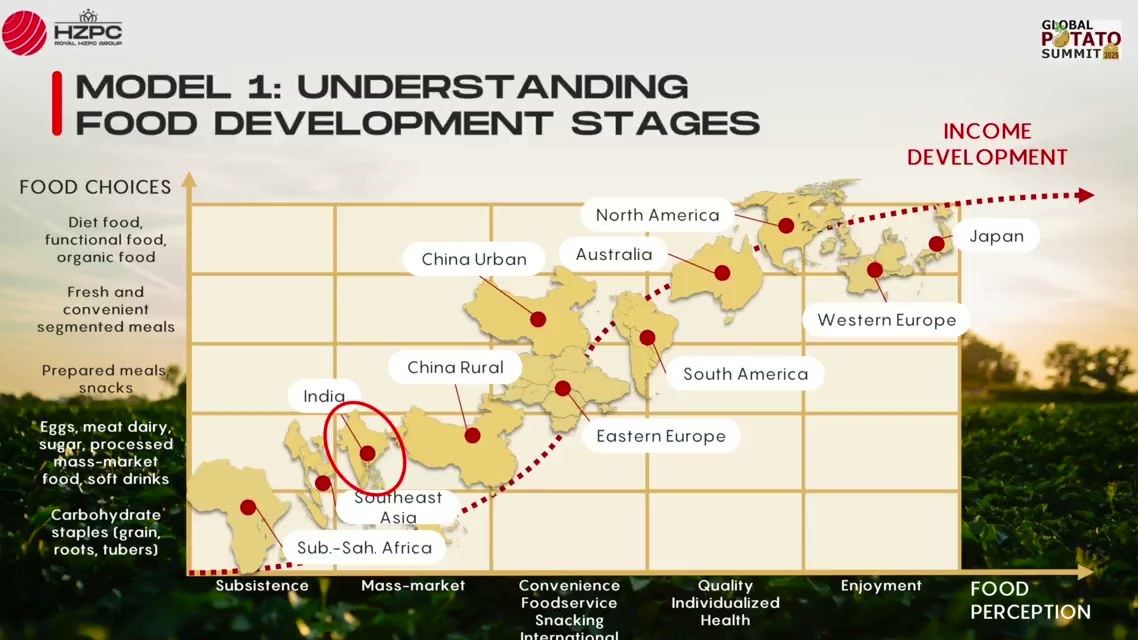
His first model plots what people choose to eat against how they think about food. Countries move along the same curve as incomes rise, he said, some of them over decades, and India can move faster by learning from those that went first. “Don’t invent the wheel yourself.”
Model 1 on his slide: India circled at the mass-market stage, beside Southeast Asia.
India is in the bottom-left corner today, he said, already moving in places towards the next one. The point is less about production than about reading where consumers at home and abroad are heading, and adapting to it.
05 · The value chain
Home delivery and differentiation: what changes for the table potato?
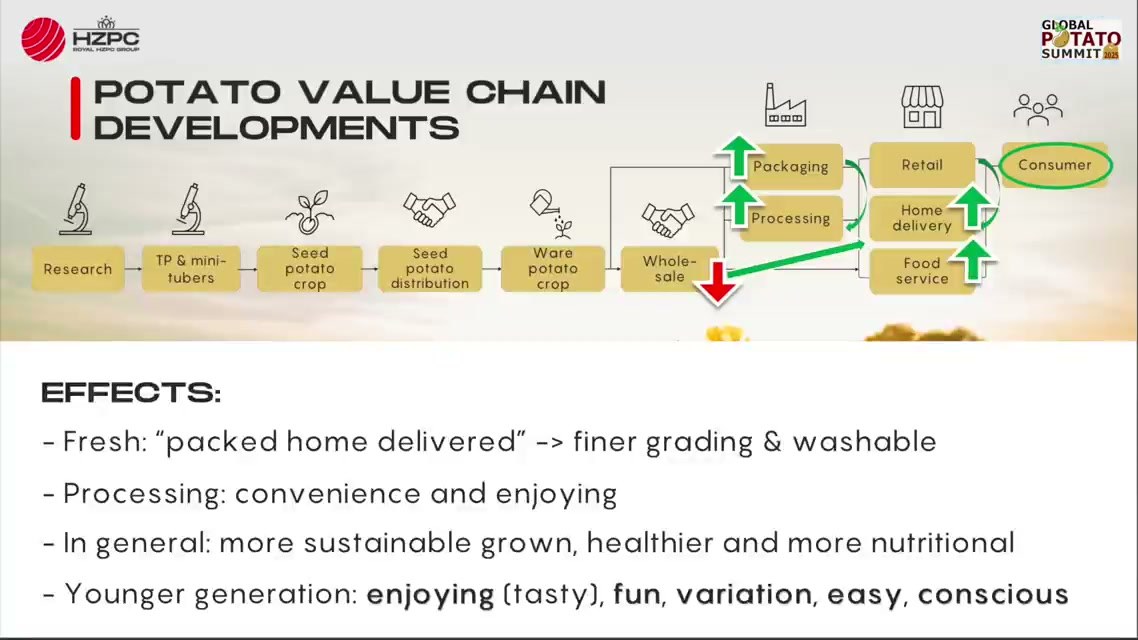
Verveld drew the chain from research and mini-tubers through seed, ware crop and wholesale to the consumer, with wholesale shrinking and processing, packaging, home delivery and food service growing. Two of his remarks framed the Indian table market.
85%“I hear already in the big cities, 85% of you are buying home delivery.”His impression, as he said, not a survey figure.
90%of India’s table-market potatoes are “still very traditional”, he said.His estimate.
Potato value chain developments, with the effects he listed.
Fresh: “packed home delivered” potatoes need finer grading and washable varieties with better presentation.
Processing: convenience and enjoyment keep it growing.
In general: more sustainably grown, healthier and more nutritious.
Younger generation: enjoying, fun, variation, easy cooking and conscious of sustainability.
The word that kept returning, he said, is differentiation. Where India’s table market goes next is the move many other countries have already made, from one traditional potato to potatoes chosen for a purpose.
06 · Varieties
Why new potato varieties fail if you grow them the old way
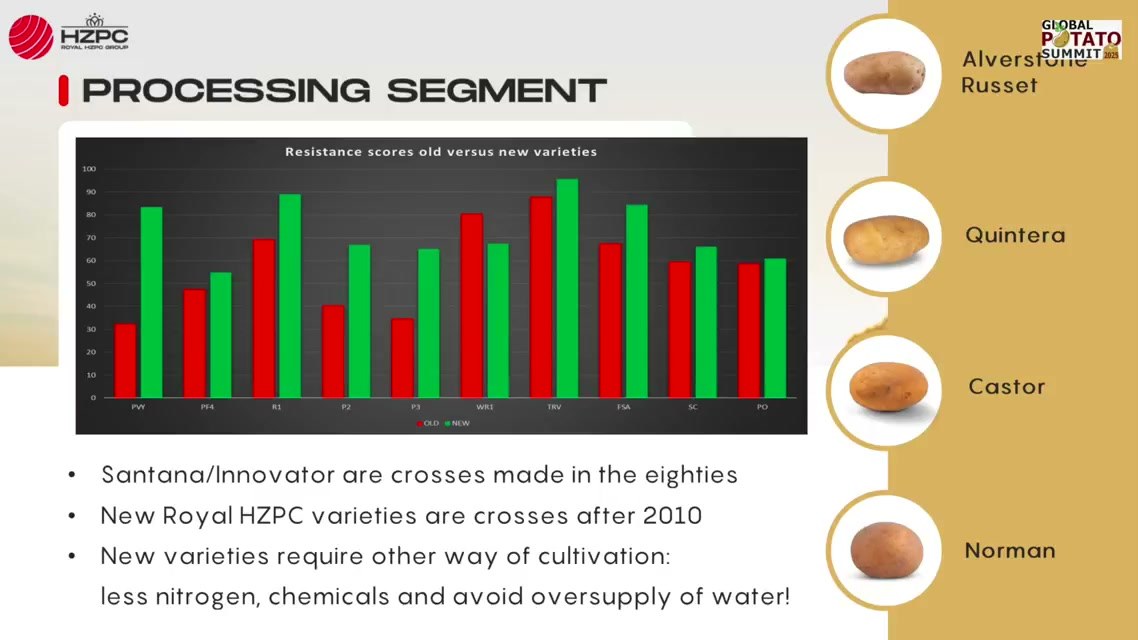
His example came from processing. The varieties that built the industry are old crosses; the ones breeders are introducing now are much younger, and he said they carry more added value.
Crossed in the 1980sSantana, Innovator
The processing varieties the industry knows, whose growing recipes took years to learn.
Crossed after 2010New Royal HZPC varieties
His slide showed Alverstone Russet, Quintera, Castor and Norman, with higher resistance scores than the older varieties on most traits.
“Resistance scores old versus new varieties” in the processing segment, as HZPC presented them.
The catch, in his words: “you should not grow them on the same way like the old varieties.” Every variety needs its own way of growing. His slide spelled out what that means for the new ones:
Less nitrogenthan the older varieties were given.
Fewer chemicalsin the crop programme.
No oversupply of waterin irrigation.
He pointed to Santana itself: processors who have worked with it for years took a long time at the start to find “the real recipe to produce a good Santana”. The value chain, he said, has to learn and keep learning how to grow each variety.
07 · Model 2
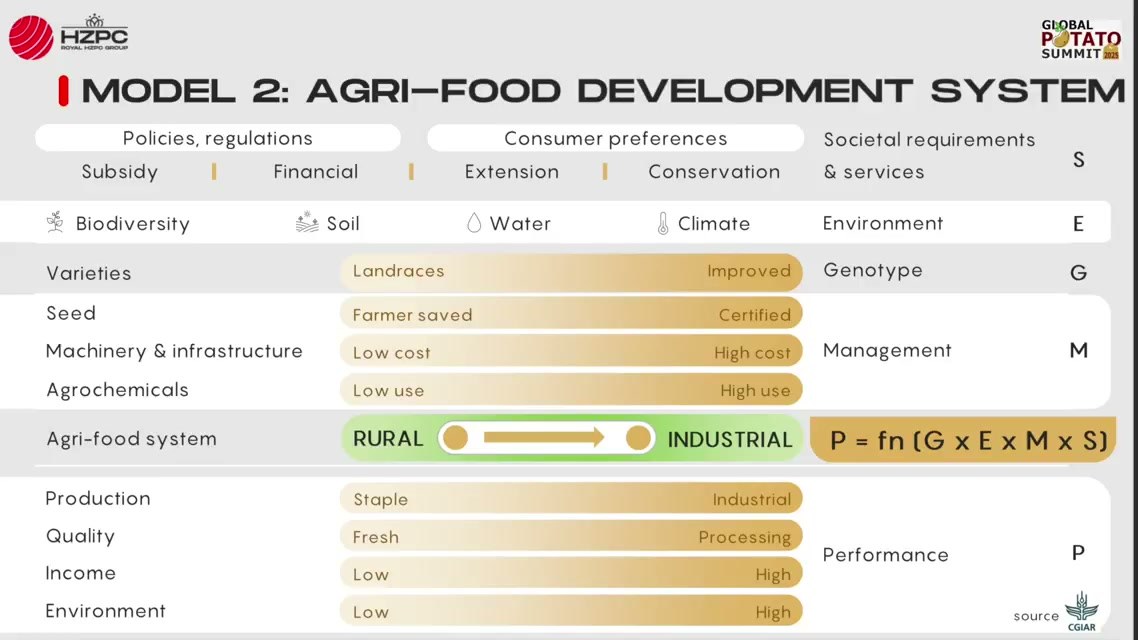
What decides a potato crop’s performance? P = G × E × M × S
His second model, credited on the slide to CGIAR, the global agricultural research partnership, treats a crop’s performance as a product of four things. Miss one, he said, and it will not work; start wrong and there is no good end.
P = fn(G × E × M × S)
GGenotype
Varieties, from landraces to improved. Each has its own recipe.
EEnvironment
Biodiversity, soil, water and climate. Gujarat is not UP.
MManagement
Seed from farmer-saved to certified, machinery, agrochemicals.
SSociety
Policy, subsidy, finance, extension and what consumers want.
Model 2: the agri-food development system, rural to industrial. Source on the slide: CGIAR.
“Climate in Gujarat is different than here in UP, which means also different management,” he said. Moving from lower to higher yields means getting every part right, from seed quality and mechanisation to irrigation and storage. The Netherlands and the US made that shift long ago; India, he said, is “maybe somewhere in the middle”, and has to prepare to play in the global potato business.
08 · The breeder’s part
What does a potato breeder owe India?
Breeders carry responsibility too, Verveld said. Royal HZPC Group has been in India for more than 12 years, in his words, and is still learning. India’s many microclimates and differing abiotic stresses change what potato breeding has to deliver, and the climate shifts from one season to the next.
The answer he gave is genetics that can deal with climate change and different diseases, but above all adaptability: varieties that cope with conditions that keep changing. It is not a question of making a variety and bringing it, he said. The aim is for India to succeed in its own market and in part of the world beyond it.
His five asks of India’s potato trade
Open borders and sign bilateral agreements so India can export seed potatoes.
Learn from countries that have already moved along the food-development curve, and move faster.
Read where consumers are heading, at home and abroad: home delivery, convenience, differentiation.
Grow new varieties to their own recipe, with less nitrogen, fewer chemicals and no oversupply of water.
Get genotype, environment, management and society right together; missing one breaks the rest.
Questions about the talk
Who is Herman Verveld?
Herman Verveld is Chief Commercial Officer of Royal HZPC Group, the Dutch potato breeding and seed company. He gave the Expert Insights session on global trends in potato demand, production and processing and India’s future role at Global Potato Summit 2025 in the National Capital Region.
What did HZPC say about India at the Global Potato Summit?
Verveld said India, number two in potato, sits where the world’s population is growing, has a large and growing home market, and could export more, including seed, if borders open through bilateral agreements. He expects India’s table market to move from traditional to differentiated potatoes.
Can India export seed potatoes?
Verveld said that today it is almost impossible, and asked the government to open borders and sign bilateral agreements with other countries so that India can export seed to the growing markets around it.
Why do new potato varieties need different cultivation?
Verveld said every variety needs its own way of growing. His slide said Royal HZPC’s post-2010 varieties need less nitrogen, fewer chemicals and no oversupply of water, compared with 1980s crosses such as Santana and Innovator.
What is the P = G × E × M × S model?
It is the agri-food development model Verveld presented, credited on his slide to CGIAR. It treats crop performance as a function of genotype, environment, management and society, and holds that missing any one of the four stops the system working.
When is the next Global Potato Summit?
Global Potato Summit 2026 runs on 16 and 17 December 2026 at the Mahatma Mandir Convention and Exhibition Centre in Gandhinagar. IndianPotato.com handles enquiries for stalls, delegate passes and introductions.
Indian Potato Team
The editorial desk at IndianPotato.com. This report gives the speaker’s own view, in his words; the figures are his and his slides’.
Omnivent's Eroll van Groenewoud at Global Potato Summit 2025: design stores to run four to five hours a day, renovate before you build, decide early. The talk, the slides, and what a store owner should take from it.
Same region, same cold store, same temperature and humidity — and one lot comes out fine while the other does not. Sovindra Chaudhary of Agristo Masa on where potato quality is actually decided: maturity, curing, bruising, field heat, handling and transport, long before the chamber door.
Diesel, waiting hours, empty kilometres and rejected loads never appear on a transporter's invoice. After six years moving potatoes from farm gate to factory gate, Sovindra Chaudhary opens the ledger he actually works from.
 Indian Potato Team · Editorial Desk · 27 September 2026