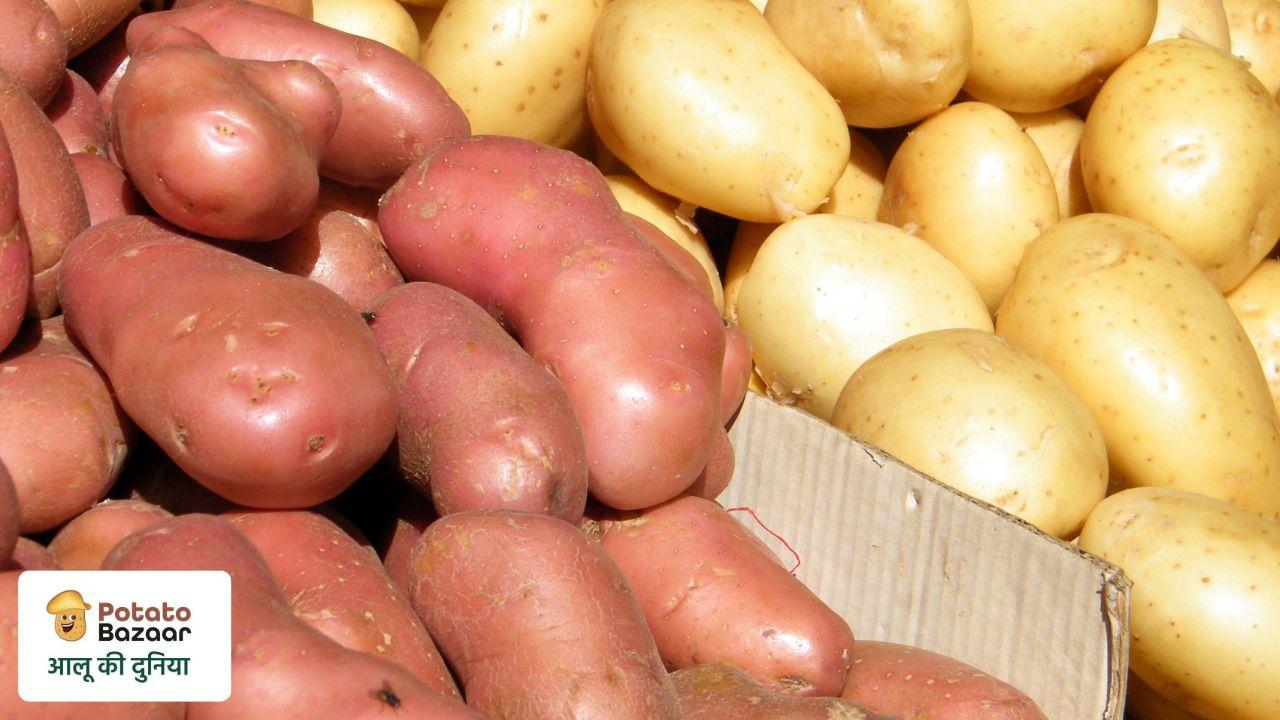
"Prices moved because of X" is almost always an incomplete answer. Potato price formation is the interaction of four distinct forces at once — here's each one on its own, and why the interaction between them matters more than any single force alone.
Ask why potato prices moved this week and you'll usually get a one-line answer — "arrivals are heavy," or "demand is weak," or "storage stock is high." Each of those can be true and still be an incomplete explanation, because potato price formation is never the product of one force acting alone. It's the interaction of several forces operating at the same time, sometimes reinforcing each other and sometimes pulling in opposite directions. Understanding each force individually is useful. Understanding how they interact is what actually explains why a price moved the way it did, rather than the way a single-factor story would have predicted.
This piece breaks price formation into four distinct forces — arrivals, storage, demand and seasonality — treats each on its own terms, and then focuses on the part that usually gets skipped: how they interact. It's a companion piece to two others from the same series: one on the multi-year price cycle these forces play out across, and one that zooms into how the arrival calendar shapes a single season. This piece is the synthesis — the framework the other two sit inside.

Before looking at how they interact, it's worth being precise about what each force actually is:
The volume of fresh potato physically reaching mandis on a given day — the supply-side flow straight from the field, concentrated around each producing region's own harvest window.
The buffer of potato already moved into cold storage, released gradually across the season. Storage stock smooths what would otherwise be an all-or-nothing supply picture tied purely to harvest timing.
Not one demand, but at least three that don't always move together — fresh table consumption, processing demand from chips and fries lines, and export pull toward international buyers.
The calendar context that times when arrivals peak, when storage releases happen, and when each demand channel is strongest — the "when" that shapes how the other three forces actually show up.
Of the four forces, demand is the one most often treated as a single number when it's actually three separate channels layered on top of each other. Fresh table demand is the largest by volume in most markets and moves with household consumption patterns and retail prices. Processing demand — chips lines, fries lines, and the wider snack-food sector — runs on its own contracting cycle, often locked in ahead of the season rather than reacting day to day, and increasingly represents a meaningful and growing share of total offtake as India's processing sector expands. Export demand pulls a further, comparatively smaller share toward international buyers, and moves on its own calendar shaped by destination-market seasons and trade conditions rather than domestic ones.
These three channels don't rise and fall together. Processing demand can stay firm while fresh-table demand softens seasonally, or export demand can pull additional volume even while domestic prices look comfortable. Treating "demand" as one undifferentiated force misses exactly the kind of divergence that often explains why a price move doesn't match what the headline supply picture alone would predict.
This is the part a single-factor explanation always misses. The four forces don't operate in isolation — they reinforce or offset each other, and which one is doing the offsetting changes what the resulting price actually tells you.
A single force shifting — heavier arrivals, thinner storage stock, softer demand — is a partial signal, not a complete one. Whether price actually moves, and by how much, depends on what the other three forces are doing at the same time. Reading one force in isolation is how a genuinely surprising price move gets misread as random noise, when it was really just a second or third force offsetting the first.
The value of separating price formation into four forces isn't academic — it changes how you interrogate a price move instead of just reacting to it. Before treating any single day's price as a signal, it's worth asking where each of the four forces stood at that moment: was it a harvest-peak arrivals window or a lean-season one, was storage stock unusually heavy or thin for the time of year, which demand channel was actually moving, and did the timing line up with what the seasonal calendar would predict anyway. A price move that only lines up with one force, and contradicts what the other three would suggest, is worth a second look rather than an immediate explanation.
None of the four forces is more "real" than the others, and none is a reliable stand-alone predictor on its own. Arrivals data without a demand check tells you about supply, not price. A firm demand read without checking the storage picture tells you about one side of the balance, not the outcome. The discipline this framework asks for isn't complicated — it's simply not stopping at the first force that offers a convenient explanation, and checking whether the other three actually agree with it before treating a single-factor story as the full answer.
Potato Bazaar's Market Analytics brings historical price trends, arrival patterns, seasonal signals, and regional demand data into a single view — helping potato businesses turn data into better production, storage and selling decisions, including reading how arrivals, storage, demand and seasonality are interacting on any given day rather than reacting to one number in isolation.
Arrivals (fresh field supply reaching mandis), storage stock (the buffer released gradually across the season), demand (fresh table, processing and export channels, which don't always move together), and seasonality (the calendar timing that shapes when the other three forces show up). Price formation is the interaction of all four, not any single one.
Because fresh-table consumption, processing demand from chips and fries lines, and export demand move on different cycles and don't always rise or fall together. Processing demand can stay firm while fresh demand softens seasonally, or export pull can add volume even when domestic prices look comfortable — treating demand as a single figure misses that divergence.
Yes — if a demand-side force, such as strong processing or export offtake for that window, is offsetting the supply-side pressure from arrivals at the same time. That's why reading arrivals in isolation can misread the actual price outcome; the other forces active at that moment matter just as much.
Seasonality doesn't push price directly the way arrivals, storage and demand do. Instead, it sets the timing and intensity with which those three forces actually show up — the same underlying supply-demand balance can look different depending on where the seasonal calendar sits when it plays out.
Before reading a single price move as a clear signal, check where each of the four forces stood at that moment — the arrivals window, the storage stock level, which demand channel was actually active, and whether the timing matched the seasonal calendar. A move that only lines up with one force and contradicts what the other three suggest is worth investigating further rather than explaining away with a single-factor story.
Get the latest market intelligence, price trends, and industry news delivered to your feed.
Where the industry reads it first
Growers, traders, processors and cold-store operators, in one place. Prices, policy and the stories behind them — forwarded, not algorithm-ranked.
Potato Prices
Today's mandi rates
Variety Guide
Compare all 64 varieties
Export Guide
Step-by-step process

Potatoes.News launched Potato Market Prices on 26 September 2026: confirmed potato prices from 16 markets on one page. How to read it, and where India sits.

India's exported potato fetched ₹18.86 ($0.216) a kilo in 2025. Canada's fetched ₹64.08 ($0.735), the Netherlands' ₹46.30 ($0.531); eleven big exporters averaged ₹34 ($0.39). Only Pakistan sold cheaper. Nepal took 55% of the tonnes at ₹11.92 ($0.137) — and that is half the story.

Bigger is not cheaper. Lay's ₹5, ₹10 and ₹20 packs cost ₹38–42 per 100 g; the ₹48 pack costs ₹58–60. Bingo's ₹50 packs cost 20–40% more per gram than its ₹20 packs. Every pack, from the printed MRPs, and the two pouches that break the rule.