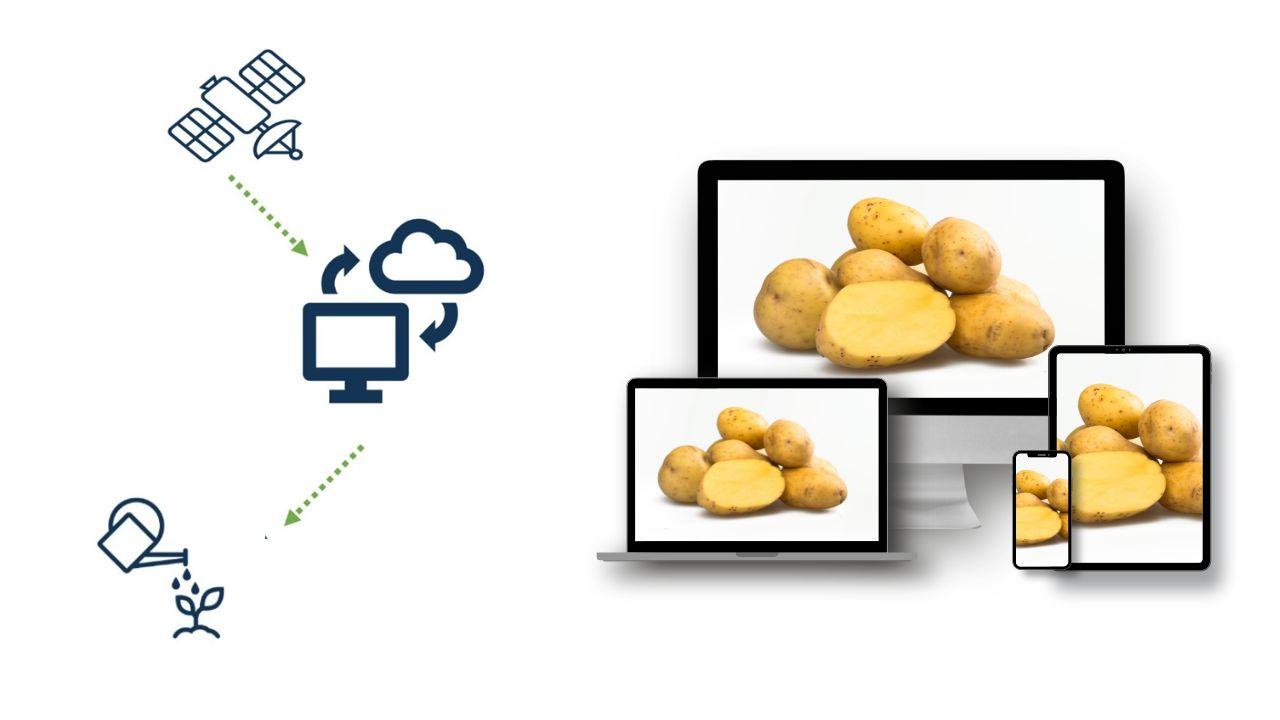
AI-powered crop diagnostics, instant expert advisory, and data-driven decisions are transforming how Indian potato farmers fight disease, optimise yield, and protect their margins.
Potato farming technology — and specifically the new generation of AI-powered crop diagnostics and advisory apps — is quietly rewriting how Indian potato farmers respond to disease pressure, weather risk, and market timing. India produced 58.57 million tonnes of potatoes in 2024-25 (PIB Final Estimate), making it the world’s second-largest potato producer. But beneath the headline tonnage sits a structural problem: a meaningful share of that crop is lost to disease, and most of those losses are preventable — if the farmer can identify the problem fast enough to act on it.
This article walks through where the diagnosis-to-action gap actually opens up for an Indian potato farmer, the economics of those lost days, and the digital tools — including platforms like Potato Bazaar — now closing that gap. It is the second of a two-part series on technology in Indian potato; the first article looked at digital platforms in potato trading.
Late blight is the textbook example of why diagnosis speed matters. Under the cool, foggy, high-humidity conditions that define the Indian winter potato season — December through February in the plains, June through August in hill stations — Phytophthora infestans can collapse a canopy in 5 to 10 days. Once foliar lesions are widespread, the tuber damage that determines the season’s yield is already underway. The window between “something looks off” and “30–40% of the crop is lost” is brutally short.
Most Indian potato farmers operate inside three structural constraints that make that window even harder to hit. First, symptoms across the major potato diseases are easy to confuse — late blight, early blight, alternaria leaf spot, and bacterial wilt all start with discoloured lesions that look broadly similar from a distance, and the corrective action for each is different. Second, agri-extension officers are spread thin: in many districts the official ratio is one extension officer per 1,000 or more farmers, and reaching one in person can take days. Third, by the time a sample reaches a Krishi Vigyan Kendra (KVK) or a regional ICAR-CPRI diagnostic facility, the typical farmer has already lost seven to fourteen days — often the entire window in which preventive spraying could have changed the outcome.
The cost of that delay is not theoretical. For a farmer cultivating one hectare of potatoes at average Uttar Pradesh or Gujarat yields, losing a week to a misdiagnosis can be the difference between profit and loss for the entire season. The deeper reference on disease identification by symptom and region is in our 24-disease compendium — but the practical question for the farmer in the field is simpler: can I get a reliable answer today, not next week?
The diagnostic challenge has both a biological side and an institutional side. On the biological side, common Indian potato diseases produce overlapping visual signatures. Late blight starts as water-soaked lesions on leaflets; early blight presents as concentric brown “target spot” rings; alternaria leaf spot looks similar in early stages; fusarium wilt and bacterial wilt both produce wilting plants that drop leaves. A farmer relying purely on visual judgement — without years of side-by-side training — will often confuse two or three of these.
The institutional side compounds the problem. A laboratory-confirmed diagnosis (PCR, ELISA, or pathogen culture) is the only definitive answer for several diseases, and the nearest accredited testing facility may be 50–200 km away. Most Indian potato disease management literature is written in English; vernacular adaptations exist but are inconsistent and rarely searchable on a phone. And regional variation matters: late blight pressure in the Uttar Pradesh rabi crop has a different temporal profile from alternaria pressure in Gujarat, and the right timing of preventive sprays differs accordingly.
For a farmer with two or three hectares, none of this is a question of intelligence or effort — it is a question of access. A diagnosis that takes seven days, requires travel, and arrives in a language full of Latin pathogen names is fundamentally not a tool that fits the farmer’s decision window.
Quantify the impact and the case for faster diagnosis becomes self-evident:
For a one-hectare grower yielding 25 tonnes (250 quintals) at ₹1,000 per quintal, even a 20% yield loss is roughly ₹50,000 wiped out. That figure often is the difference between profit and loss for the season — and it does not capture the secondary cost of distress sale at lower mandi prices when output quality drops. The farmer who diagnoses and acts on day one keeps that ₹50,000. The farmer who waits a week typically does not.
The shift now underway in Indian agriculture is structural, not incremental. Smartphone penetration in rural India crossed 60% in 2024 (TRAI/IAMAI data), giving the average farmer a connected device that can capture, upload, and receive analysis in real time. AI-based image recognition for plant disease — trained on lakhs of crop images, including Indian field conditions — is now accurate enough to outperform untrained visual diagnosis on the most common diseases. Weather and soil data, integrated with disease-pressure models, allow predictive alerts: not just “you have late blight,” but “late blight conditions will be conducive in your district over the next five days.”
The cumulative effect is a move from reactive to predictive. The reactive model is: damage occurs, farmer notices, farmer seeks help, response arrives, action is taken — typically with the worst of the damage already locked in. The predictive model is: weather and field signals trigger a warning, farmer reviews the recommendation, preventive action is taken before symptoms appear. The economics of these two models are not even close.
What is new is not the science behind any single component — image recognition, weather modelling, and IPM principles have all existed for years. What is new is the integration: a single app on a farmer’s phone that combines disease ID, weather forecast, advisory text in vernacular, expert chat for complex cases, and a clear next-step recommendation. That bundle did not exist for Indian potato five years ago. It does now.
Not every “agri-tech” app delivers what a working farmer needs. The practical checklist for a useful crop diagnostic platform — one that actually changes outcomes in the field — comes down to seven attributes:
An app that hits four of these is useful. An app that hits all seven is structurally different from anything Indian potato farmers had access to five years ago.
What does this look like for an actual farmer’s working day? The integrated workflow now possible — and that platforms like Potato Bazaar are building toward — runs roughly as follows:
Morning field check. The farmer walks the field, photographs any leaflet that looks off, and uploads the image to the crop diagnostic app. Within seconds, the AI returns a probable diagnosis — late blight, early blight, alternaria, or a benign condition like nutrient deficiency — along with confidence level and recommended next step. If the language preference is Hindi or Marathi, the recommendation arrives in voice form for low-literacy users.
Midday advisory. If the diagnosis is uncertain or the situation is unusual, the same app surfaces an expert agronomist over chat. The conversation happens in vernacular, with the photos already attached, and a treatment recommendation typically lands within a few hours instead of a few days.
Throughout the day. The app runs weather and disease-pressure forecasts in the background — so the farmer is alerted when the next 48 hours are conducive to late blight even before any symptoms appear. Mandi prices for the relevant variety and grade are visible in the same view, so the farmer is also tracking when to harvest and when to hold.
Pre-harvest and sale. When the crop is ready, the same platform connects to variety-aware buyers — processors needing chip-grade, fries-grade, or table-grade tubers — and lets the farmer list the lot directly to verified buyers. The diagnosis, the protection, and the sale all live inside the same app.
A diagnosis is only as useful as the action it enables. In the Indian potato context, that action splits into two halves: buying the right input fast, and selling the harvested crop at a fair price.
On the input side, the gap is not knowing what to spray — the diagnostic now tells you. The gap is finding the recommended fungicide, in stock, at a reasonable price, from a retailer close enough to reach in time. Most preventive sprays are timing-sensitive: a 24-hour delay between diagnosis and application can substantially reduce efficacy. Platforms that connect the diagnosis to a verified input-supplier network — even simply showing which retailer in the district has the product in stock — close that gap.
On the output side, the question is who pays the best price for the lot the farmer has produced. Selling to the local trader is fast but often leaves money on the table; selling further upstream — directly to a processor needing chip-grade or fry-grade tubers — usually pays better but requires discovery, negotiation, and quality verification. Digital platforms that match growers to verified processors, traders, and exporters compress this discovery time and tighten the price spread.
The farmer who can buy and sell potatoes through the same digital platform that diagnoses crop disease and tracks weather has a fundamentally different decision-making position from the farmer working through five separate channels with five separate gatekeepers.
The trajectory is clear. Digital adoption in Indian agriculture is growing roughly 18–22% annually (NITI Aayog estimates), and government initiatives — the Digital Agriculture Mission, AgriStack, and the digital public infrastructure layer being built across rural India — are removing the structural friction that previously kept these tools out of farmers’ hands. ICAR-CPRI’s own work on the Jhulsacast / INDO-BLIGHTCAST late-blight forecast is itself a digital product, distributed through state extension networks and KVKs.
The next five years are going to be transformative for farmers who adopt these tools early. The farmer who ties together disease diagnosis, weather alerts, input procurement, and direct buyer access through a single digital platform builds a structurally lower-cost, lower-risk operation than the farmer who continues to work through fragmented offline channels. As demand for processing-grade potato — chip, fry, starch, flake — keeps rising in India, the farmers who can prove quality through traceable digital records will capture a disproportionate share of premium prices.
None of this replaces good agronomy, sound seed-system discipline, or the role of the local KVK. What it does is multiply the reach and timeliness of those resources — turning a system that was reactive, fragmented, and slow into one that is predictive, integrated, and fast. For India’s roughly 23 million potato-farming households, that shift is the most important thing happening to the crop’s economics in this decade.
The farmer who can buy and sell potatoes, diagnose disease, and access expert advisory through a single integrated app — built specifically for the Indian potato ecosystem — is the farmer best positioned for the next harvest cycle. Platforms like Potato Bazaar are pulling those threads together; the question for any working farmer in 2026 is no longer whether to engage with these tools, but how soon.
Potato Bazaar combines AI-powered crop diagnostics, vernacular advisory, real-time mandi prices, and direct buyer connections — built specifically for Indian potato farmers. Free to download.
 Download Now
Potato Bazaar App
Download Now
Potato Bazaar App
Get the latest market intelligence, price trends, and industry news delivered to your feed.
Where the industry reads it first
Growers, traders, processors and cold-store operators, in one place. Prices, policy and the stories behind them — forwarded, not algorithm-ranked.
Potato Prices
Today's mandi rates
Variety Guide
Compare all 64 varieties
Export Guide
Step-by-step process

Potatoes.News launched Potato Market Prices on 26 September 2026: confirmed potato prices from 16 markets on one page. How to read it, and where India sits.

India's exported potato fetched ₹18.86 ($0.216) a kilo in 2025. Canada's fetched ₹64.08 ($0.735), the Netherlands' ₹46.30 ($0.531); eleven big exporters averaged ₹34 ($0.39). Only Pakistan sold cheaper. Nepal took 55% of the tonnes at ₹11.92 ($0.137) — and that is half the story.

Bigger is not cheaper. Lay's ₹5, ₹10 and ₹20 packs cost ₹38–42 per 100 g; the ₹48 pack costs ₹58–60. Bingo's ₹50 packs cost 20–40% more per gram than its ₹20 packs. Every pack, from the printed MRPs, and the two pouches that break the rule.