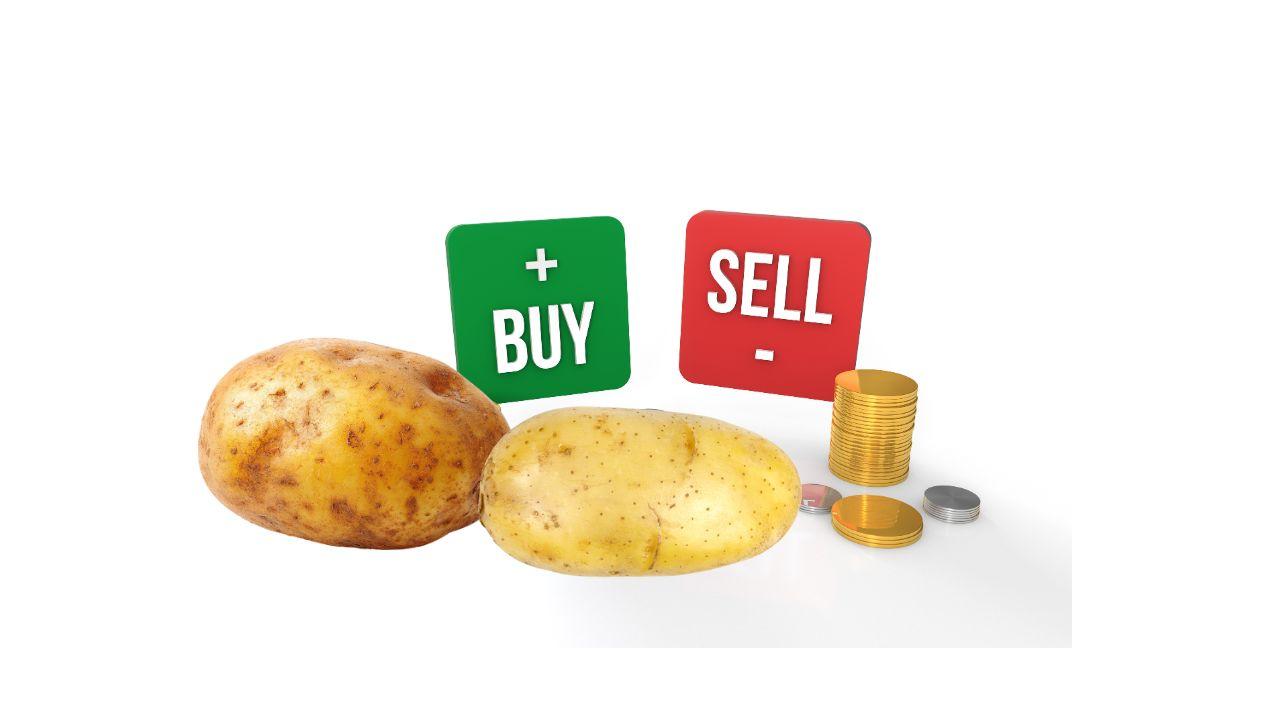
Connect with potato farmers, traders, cold storage owners, processors, and exporters across India's potato value chain.
India produces more than 55–60 million tonnes of potatoes annually, supplying the raw material for chips, fries, starch, flakes, and snacks across the world's second-largest national vegetable economy. For anyone looking to buy and sell potatoes in India — particularly processing-grade potatoes that meet the dry-matter and reducing-sugar specifications major plants demand — the market is surprisingly fragmented. Between the field where the tuber is harvested and the fryer, kitchen, or chip line where it ends up, an enormous amount of value quietly drains out of the chain. Some of it goes to the people who deserve to be paid. A great deal does not. This article is about where the leakage happens, why it persists, and how a new generation of digital platforms is starting to plug it.
The Department of Agriculture & Farmers' Welfare placed India's 2024-25 potato production at 585.71 lakh tonnes — 58.57 million tonnes in its Final Estimates of Horticultural Crops. The crop has tracked between 53 and 60 MT for most of the last six years, with year-on-year swings driven mostly by weather rather than by area. Crop area has stayed broadly flat at around 2.2 million hectares; the trade itself moves an enormous volume but does so through a remarkably fragmented set of channels.
Industry assessments and market intelligence work over the last decade place more than four-fifths of that volume in unorganised channels — local mandis, commission agents, village aggregators, and informal cash trades that leave no electronic trail. The remaining share moves through processor contracts, organised cold-chain operators, and a small but growing layer of digital intermediaries.
The trade is geographically concentrated. Agra and Farrukhabad in Uttar Pradesh form the largest single mandi belt; Indore in Madhya Pradesh feeds processing as much as fresh markets; Deesa in Gujarat's Banaskantha district anchors the western processing-grade flow; Jalandhar and Ludhiana in Punjab manage the seed-bowl trade; and Hooghly's network in West Bengal handles the country's second-largest production base. Mandi-price spreads across these hubs on the same day routinely run ₹50-150 per quintal — a gap that, multiplied across millions of quintals, represents real money mis-allocated by the system rather than legitimately earned.
Every layer between the farm gate and the final buyer extracts a margin, and most of those margins are invisible at the headline price. The visible commission paid to a mandi-licensed agent typically ranges from four to eight per cent of the gross sale value depending on state regulation and local practice. That is the smallest of the costs.
The bigger costs hide in the operational detail. Trucking from a UP village to a Gujarat processor can cost more than ten per cent of the consignment's value once fuel, driver, loading, and detention are added up. Loading and unloading charges are paid at both ends, often more than once if the consignment passes through an intermediate mandi. Grading is sometimes done at the buyer's gate and sometimes at an intermediary's yard; either way it adds handling and time. Bagging in 50-kilogram jute or PP woven sacks is itself an industrial cost. Mandi entry fees, cess, and weighbridge charges add another layer at most state markets.
A rough but honest reconstruction of a typical chain looks like this: a farmer in Agra receives, say, ₹800 per quintal at the mandi gate; a processor in Gujarat is paying ₹1,200 for the same quality and variety landed at their plant. The four-hundred-rupee gap is not a single intermediary's margin. It is commission plus transport plus loading and unloading plus grading plus bagging plus mandi fees plus the small but persistent cuts taken at every handover. Industry estimates suggest the cumulative leakage across these layers can exceed thirty per cent of farm-gate value depending on distance, contract terms, and the number of intermediaries the consignment passes through. None of these costs are necessarily wrong; many are unavoidable. But many of them are also opaque, duplicated, and absorbed by the farmer rather than negotiated.
Potato is bulky, water-rich, and surprisingly fragile. Every additional handling event — every loading, unloading, transfer between trucks, hour spent in a mandi yard, or transit through monsoon humidity — carries a small but cumulative penalty in the form of bruising, skin damage, pressure injury, and physiological deterioration. Buyers know this. They discount damaged lots aggressively, and the discount almost never returns to the farmer who suffered the original handling loss.
The mathematics is brutal. A consignment that loses three per cent of its weight to shrinkage during a long, hot transit, then gets ten per cent of its tubers downgraded for visible damage on arrival, has lost something close to thirteen per cent of its realised value before the buyer even negotiates. Pre-cooled, well-graded, and rapidly moved consignments capture meaningful price premiums precisely because so much of the rest of the trade arrives with these losses baked in. That is one of the reasons farmers and traders who can access well-managed cold storage are able to extract more value across the season — not because the storage cost is cheap, but because it slows the quality-decay clock long enough to clear material into a stronger price window.
Quality also drives access to the highest-paying channel of all: processing. A frozen-fries or chip line will pay a meaningful premium over the table market for tubers that meet specification on size, shape, dry matter, and reducing-sugar content. But it will reject — or steeply discount — any consignment that fails specification. The quality discipline required to access those premiums is impossible to enforce when the consignment passes through five separate handlers between the field and the plant.
Even setting handling and transaction costs aside, Indian potato trade operates on a strikingly thin information base. A farmer in eastern Uttar Pradesh deciding whether to sell, store, or hold a consignment typically depends on a handful of village-level data points: the local commission agent's verbal quote, prices reported by neighbouring farmers, and rumours of what Agra or Delhi traders paid yesterday. Live mandi-price visibility across the country is a recent and still imperfect phenomenon.
The result is genuine price inefficiency. The same variety of the same grade can sell at materially different prices across markets less than a thousand kilometres apart on the same day, not because demand differs that dramatically, but because the information needed to arbitrage the gap is not in the right hands. Farmers cannot easily compare prices in real time. Buyers cannot easily aggregate supply from dispersed sellers without going through a chain of agents. And the demand signals that processors and bulk buyers are sending — “we need 5,000 tonnes of Chipsona-grade material delivered to Indore over the next ten days” — rarely propagate back to the farms that could supply them in time to influence harvest and storage decisions.
The structural fix for an information problem is, almost by definition, an information system. Over the last few years, a small but growing number of digital platforms — some agriculture-wide, some commodity-specific — have started to reshape how the Indian potato trade discovers price, finds counterparties, and matches supply to demand.
The basic mechanics are straightforward. A seller, whether a farmer or a trader, posts a structured listing: variety, quantity, location, photos, expected price, and any quality notes the lot deserves. A buyer browses or searches the same listings, filters by what they need, and contacts the seller directly. Price visibility is built in: a glance at recent listings tells both sides where the market is sitting, not just where their own counterparty wants it to sit. For larger transactions, a Request for Quotation (RFQ) lets a buyer specify exactly what they need and invites multiple qualified sellers to bid. For sellers willing to plan production around a buyer commitment, structured contract farming arrangements can be negotiated transparently rather than through the rumour mill.
None of this eliminates the physical reality of grading, transport, and handling. Potato is still bulky and still needs cold storage. But every layer of intermediation that exists primarily because the buyer and seller could not find each other, or could not agree on a fair price without an arbitrator, becomes optional in a transparent market. That is the structural shift digital platforms make possible: not the disappearance of the trade, but the redistribution of value within it.
Most digital agricultural marketplaces in India are commodity-agnostic — they list potato alongside onions, pulses, spices, and several dozen other crops, each with its own peculiar grading, storage, and contracting conventions. One such platform that has emerged specifically for the potato ecosystem is Potato Bazaar, an Android-first app that focuses entirely on the potato value chain and the actors who operate within it: farmers, traders, processors, cold-storage owners, transporters, and bulk buyers.
The platform's feature set reads as a direct response to the structural gaps documented above. A buy-and-sell marketplace lets sellers post structured listings — variety, quantity, location, quality notes — and lets buyers filter the inventory by what they actually need. Mandi-price visibility provides cross-market comparison so that the price discovery problem becomes one of looking, not asking. Bulk RFQ functionality lets processors and large buyers solicit quotes against precise specifications. A digital auction layer allows time-bound competitive bidding for lots whose value is high enough to justify it. Contract-farming discovery and a directory of cold-storage and transport partners round out the operational scaffolding.
The platform's editorial premise — and the reason it matters in a longer industry-analysis frame — is that a sector-specific tool can do things a general-purpose marketplace cannot. Variety-specific grading conventions, storage temperature distinctions, processing-grade specifications, regional quality preferences, and the shape of the seed-tuber market are all easier to encode when the platform does not have to accommodate the equally specific peculiarities of forty other crops. Whether the approach scales is an open question every Indian agritech faces; the bet is that focus produces enough operational depth to displace some of the cost layers that opacity currently sustains.
Digital adoption in Indian agriculture is real but uneven. The Government of India's eNAM (National Agriculture Market) initiative has linked over a thousand mandis to a unified electronic trading platform. PM-KISAN, Soil Health Cards, and digital procurement systems have built the basic digital literacy and infrastructure on which commodity-specific platforms can layer their functionality. Smartphone penetration in rural India is far higher than it was even five years ago, and Android-app distribution costs have collapsed.
The remaining gaps are real but tractable. Regional-language support is uneven across most agricultural platforms; Hindi alone is not enough in a country where the largest potato belts also read Bengali, Gujarati, Punjabi, and Marathi. Offline-friendly features matter where rural data connectivity is intermittent. Trust between buyers and sellers who have never met has to be earned slowly through delivery, dispute resolution, and patient community-building. And the regulatory framework around digital agricultural marketplaces — particularly contract enforcement and grievance redressal — is still catching up.
None of these gaps are fatal. They are the normal frictions of any market structure transitioning from informal to formal, opaque to transparent, physically intermediated to digitally enabled. The transition will not be uniform — Gujarat's processing belts and UP's cold-store corridors will move faster than the rainfed plateau or the north-eastern hills — but the direction is set. The platforms that make the transition easier will be the ones that take the time to understand the specific commodity they serve and treat farmers and small traders as customers worth designing for. The Indian potato trade is large enough, and inefficient enough, to reward those that clear it.
Check mandi prices, discover buyers, raise bulk enquiries, and connect with the potato ecosystem — all in one app.
 Download App
Get the latest market intelligence, price trends, and industry news delivered to your feed.
Where the industry reads it first
Growers, traders, processors and cold-store operators, in one place. Prices, policy and the stories behind them — forwarded, not algorithm-ranked.
Potato Prices
Today's mandi rates
Variety Guide
Compare all 64 varieties
Export Guide
Step-by-step process

Potatoes.News launched Potato Market Prices on 26 September 2026: confirmed potato prices from 16 markets on one page. How to read it, and where India sits.

India's exported potato fetched ₹18.86 ($0.216) a kilo in 2025. Canada's fetched ₹64.08 ($0.735), the Netherlands' ₹46.30 ($0.531); eleven big exporters averaged ₹34 ($0.39). Only Pakistan sold cheaper. Nepal took 55% of the tonnes at ₹11.92 ($0.137) — and that is half the story.

Bigger is not cheaper. Lay's ₹5, ₹10 and ₹20 packs cost ₹38–42 per 100 g; the ₹48 pack costs ₹58–60. Bingo's ₹50 packs cost 20–40% more per gram than its ₹20 packs. Every pack, from the printed MRPs, and the two pouches that break the rule.